Private and common parts: settling borderline cases and knowing who pays
A stain on the ceiling under the neighbours' terrace, a window to replace, a leaking drain: before ordering anything, you need to know whether the element is private or common. Your by-laws answer first, the Civil Code second.
Contents of this page
- Read the deed of divisionLook for the list of common parts and the description of your unit, amending deeds included.
- Find the charges ruleCheck in the co-ownership regulations who bears the maintenance and replacement of the element concerned.
- Apply the presumptionIf the title deeds are silent or contradict each other, an element intended for the use of all or of some is deemed common.
- Ask for authorisationFor any private works that touch a common part, have the authorisation voted at the general meeting before you start.
- Check the planning rulesAsk the municipality whether a permit is needed for works visible from outside.
The kitchen window is warping and no longer closes. Water is coming through the fifth-floor terrace and marking the ceiling of the apartment below. A neighbour announces that they are going to install a heat pump on the roof. Each time, the same question comes before all the others: does this element belong to the common parts, or is it yours?
The answer determines three things: who pays, who decides, and who is liable if the element causes damage. The legal starting point fits into one sentence. Each unit combines a private part, which belongs to you alone, and a share in the common parts, which belong to everyone (Article 3.84 of the Civil Code). Everything else comes down to knowing where the boundary runs in your building. This page belongs to the section on the legal framework of co-ownership.
Private and common parts: the by-laws decide first
The Civil Code does not draw up a list. It is the deed of division (acte de base / basisakte) that describes the property as a whole, the private partsGlossaryParts of the building that belong exclusively to the owner of a unit, such as the interior of an apartment. They are described in the deed of division. See the glossary and the common partsGlossaryParts of the building or land that belong to all co-owners according to their shares, such as the roof, the entrance hall or shared pipes. Where the title deeds are silent or contradictory, parts intended for the use of all or some co-owners are deemed common. See the glossary, and sets each unit's share (Article 3.85, § 1). The co-ownership regulations then specify each person's rights and obligations over these parts and how the charges are split.
Your first reflex is therefore to go to the documents: open the deed of division, with its amending deeds, and look for the element in question. The page on the deed of division and co-ownership regulations explains how to read them.
And if the by-laws say nothing?
Many old deeds are terse. The Civil Code then provides a presumption.
“Where the title deeds are silent or contradictory, the parts of buildings or land intended for the use of all the co-owners or of some of them are deemed to be common.”Art. 3.84, para. 3, Civil Code
Two lessons follow. The presumption works in favour of the common character, not the private character. Our reading: when in doubt, assume the element is common, and touch nothing without a decision. And an element that serves only “some” co-owners can remain common: a lift serving a single wing, a staircase leading to three apartments on the top floor.
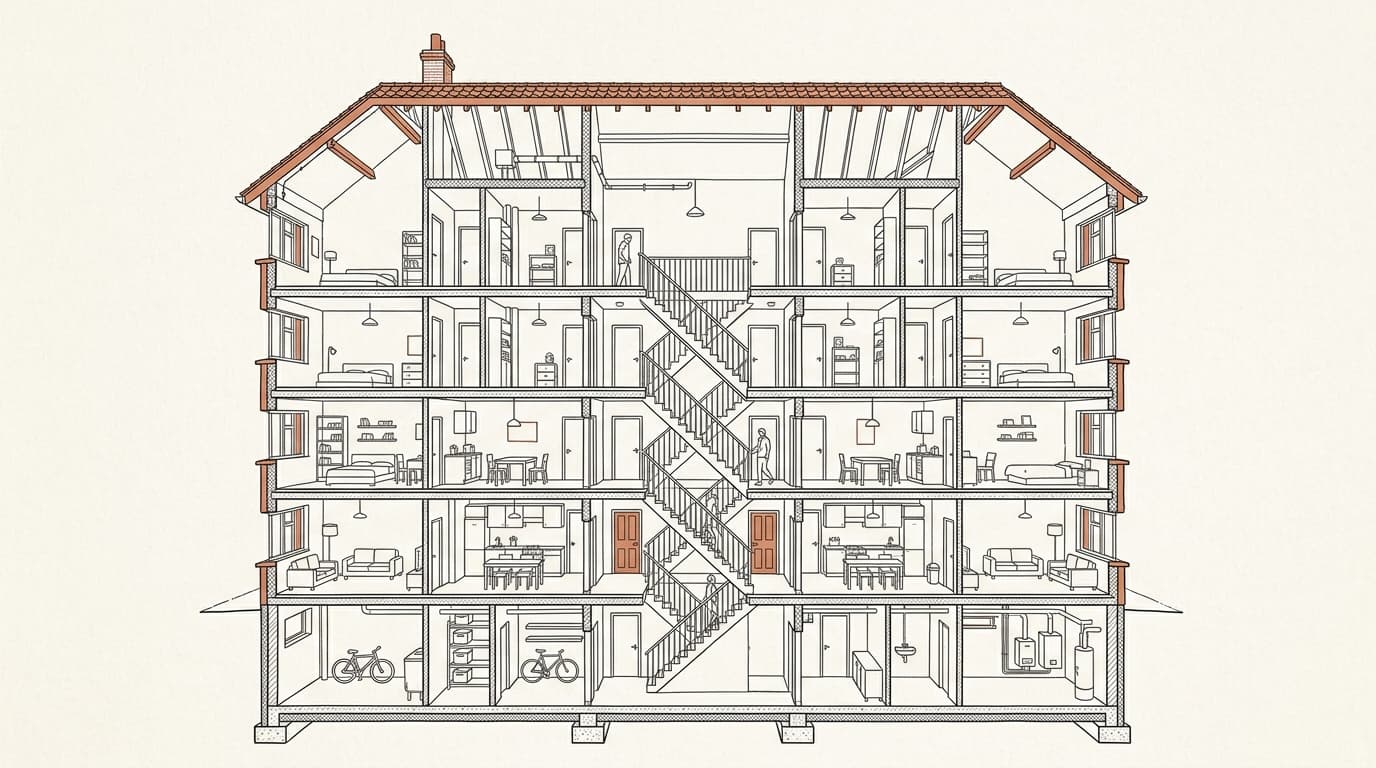
Elements that are usually common and usually private
The following table reflects what is often found in Belgian deeds of division. It does not replace reading your own by-laws, which may decide otherwise.
| Element | Usual classification | Point to watch |
|---|---|---|
| Ground, foundations, main walls, roof | Common | Structural works go through the general meeting |
| Facades, entrance hall, stairwell, lift | Common | The look of the facade is often protected by the by-laws |
| Risers and drains | Common up to the branch towards the unit | The point where it becomes private is set by the by-laws |
| Collective boiler, meter room | Common | Sometimes a specific allocation key |
| Non-load-bearing interior partitions, floor coverings, kitchen and bathroom fittings | Private | Watch out for noise nuisance if you change the floor |
| Windows, apartment front doors, shutters | Varies according to the by-laws | Model and colour often imposed |
| Balconies and terraces | Varies, sometimes common with exclusive use | Distinguish waterproofing, railings and surface covering |
What is a common part with exclusive use?
A very common solution is to leave an element in the common parts while reserving its use for a single unit. The ground-floor garden or the roof terrace reached from the top floor are the classic examples. This is known as a common part with exclusive enjoymentGlossaryRight of exclusive use over a common part, such as a garden or a roof terrace, granted to a unit by the articles. The element remains a common part; the co-ownership regulations specify how its costs are shared. See the glossary.
The holder of this right of use does not become its owner. The co-ownership regulations usually specify what remains a charge for everyone, often the waterproofing and the structure, and what falls to the user, often routine maintenance and any damage they cause. Granting or withdrawing such a use means amending the by-laws. If the amendment concerns only the enjoyment or use of the common parts, it is voted by a two-thirds majority (Article 3.88, § 1, 1°, a), and then goes before a notary.
An example: the top-floor roof terrace
Take a roof terrace that can only be reached from the sixth-floor apartment. The owner wants to replace the damaged tiles and notices that a leak is affecting the ceiling of the landing below. You read it in three stages. Does the deed of division say the terrace is private, common, or common with exclusive use? Do the co-ownership regulations specify who bears the surface covering, the waterproofing and the load-bearing structure? Failing any detail, the roof that protects the building is presumed common, because it serves everyone. A common split leaves the tiles to the user and treats the waterproofing as a common charge. Only your by-laws can confirm this.
Who decides on works, depending on the nature of the part concerned?
On your private part, you are free, subject to the by-laws, the house rules (ROI) and your neighbours' rights. Redoing a kitchen or laying parquet does not require a vote. Still, check that the house rules do not set working hours or soundproofing rules.
As soon as the works touch a common part, the general meeting (GM) takes over. The table sums up the relevant thresholds of Article 3.88; they are detailed on the page on voting rules and majorities.
| Project | Decision required |
|---|---|
| Works affecting the common parts, excluding works required by law and protective works | Two-thirds of the votes |
| Works on certain private parts decided by the owners' association (VME/ACP), with specific reasons given | Two-thirds of the votes |
| Acquisition of immovable property to become common, or disposal of common immovable property | Four-fifths of the votes |
| Division of a unit or merger of several units | Four-fifths of the votes |
| Change to the allocation of shares | Unanimity of all co-owners |
Annexing a stretch of common corridor to your apartment therefore combines several decisions: the transfer of a common part, the amendment of the deed of division and, in principle, the adjustment of the shares. We advise against presenting such a project at a general meeting without first preparing it with the notary: a vote obtained on a vague text will have to be held again anyway.
Who pays when a common element causes damage in your home?
The charges relating to the common parts, in particular maintenance, repair and renewal, are split between the co-owners according to the key set by the co-ownership regulations. A leak through the common roof will therefore be repaired at the association's expense, and everyone pays their share, including the owner who suffered the damage.
Damage inside your apartment follows a different logic: building insurance, insurance for your unit, possible recourse against whoever is responsible. The steps are explained on the pages on water damage and leaks and co-ownership insurance.
If the split seems unbalanced to you, for example because an element was added after the deed was drawn up, the law allows you to ask the court to correct a method of allocating charges that has become inaccurate as a result of changes to the building (Article 3.92, § 7). Before it comes to that, the page on co-owners' rights and obligations sets out the amicable steps.
Do, avoid
- Reread the by-laws before ordering works
- Obtain a written vote in the minutes for any visible change
- Report to the syndic any damage that comes from a common part
- Keep the invoices for works carried out on your unit
- Replacing your windows without having checked the by-laws
- Treating a private terrace as free of every common rule
- Annexing a common landing or corridor without a decision of the general meeting
- Concluding that an element is private because only you use it
Frequently asked questions
Are the windows of my apartment private or common?
It depends on your by-laws. Some deeds of division class windows as private parts while imposing a uniform model and colour, others class them among the common parts. If the title deeds are silent, the presumption in Article 3.84 of the Civil Code applies.
Can I break through a load-bearing wall in my apartment?
A load-bearing wall is usually part of the common structure. Works affecting the common parts are decided at the general meeting by a two-thirds majority of the votes (Article 3.88, § 1, 1°, b), and may also require an environmental permit in Flanders or a planning permit in Brussels.
Who pays for repairing a leak from the common riser?
Repairing the common riser is a common charge, split according to the co-ownership regulations. Damage to your apartment is in principle a matter for the insurance policies; the page on water damage explains the steps.
Can a co-owner obtain exclusive use of a common part?
Yes, if the by-laws provide for it or are amended to that effect. An amendment to the by-laws that concerns only the enjoyment or use of the common parts is voted by a two-thirds majority, then has to be recorded before a notary.
- Water damage in a co-ownership: the building or you?
Most of the time, two contracts each pay their share. The building policy, taken out by the syndic, covers the damaged structure if it includes water damage cover; your home insurance covers your contents. Repairing the leak follows a third logic: that of the part involved, common or private.
- Works in your apartment: when the GM must vote
In your private unit, you renovate without asking anyone's opinion. As soon as the works touch a load-bearing wall, the facade or a common pipe, you need a two-thirds vote of the general meeting, obtained before the first sledgehammer blow. Here is how to tell, and how to prepare the request.