Co-ownership law in Belgium: which rule applies when your articles say something else
Your articles require three quarters of the votes, a neighbour quotes Article 577, the syndic invokes the Civil Code. Here is which texts really apply to your building, and which one wins when they contradict each other.
Pages in this topic
Updated on 25.09.2026- Acte de base and co-ownership regulations: reading and amending them
In the file the notary gave you, a deed of division and co-ownership regulations decide your shares, your votes and your charges. Here is how to read them, and how they are changed.
- Building house rules in Belgium: drafting them, amending them and enforcing them against tenants
Your tenant puts the bins out on the wrong day, or the general meeting finally wants rules for bikes in the entrance hall: the house rules decide. Here is what they must contain, how to amend them and who they bind.
- Owners’ association in Belgium: the VME/ACP that runs your building, and how to check it is in order
Everyone talks about ‘the syndic’ or ‘the building’, but your call for funds is signed ‘Owners’ association’, with an enterprise number. Here is who this VME/ACP is, what it owns, and how to check it is in order.
- Private and common parts: settling borderline cases and knowing who pays
A stain on the ceiling under the neighbours' terrace, a window to replace, a leaking drain: before ordering anything, you need to know whether the element is private or common. Your by-laws answer first, the Civil Code second.
- Co-owner rights and obligations: what you can demand, and what the building expects of you
The syndic is slow to show you the accounts, the meeting has adopted a decision that harms you, or you are wondering whether you can suspend your charges. Here is what the law guarantees you, and what it expects of you in return.
- Co-ownership dispute: going to the justice of the peace, counting the deadline, trying conciliation
The general meeting has voted a decision you consider irregular, or a dispute in the building can no longer be settled amicably. Here is when and how to take the case to the justice of the peace, and why the deadline matters more than anything else.
- Co-ownership glossary for Belgium: every term in a notice of meeting or service charge statement explained
The notice of meeting talks about shares, the statement about the reserve fund, and a website you found online about fractional shares. Here is every word of Belgian co-ownership defined in a few sentences, with the Civil Code article where there is one.
The general meeting is coming up, and one item is stuck. Your deed of division (acte de base / basisakte), drafted long ago, mentions a three-quarters majority. A neighbour waves an Article 577 he found in an old judgment. The property manager (syndic) replies that ‘the Civil Code has changed’. Who is right? The answer rests on a simple idea: in a co-ownership, the texts are not equal, and the law comes before everything else.
As soon as a building has several units belonging to different owners, each with a private part and a share in common parts, it falls under co-ownership law. In Belgium, this law is no longer a separate text: it forms a section of the Civil Code, Book 3 Property, Articles 3.78 to 3.100. It applies to everyone, whether the building has three apartments in Aalst or two hundred in Ixelles.
This section gathers the pages that explain this framework: the founding documents of the building, the legal entity that manages the common parts, the line between private and common, your rights and duties, and the court that decides when things get stuck.
Where does co-ownership law in Belgium come from?
The history fits into five dates.
| Text | Main contribution |
|---|---|
| Act of 8 July 1924 | First legal regime for the co-ownership of apartments |
| Act of 30 June 1994 | Articles 577-2 et seq. of the Civil Code; the owners' association gains legal personality |
| Act of 2 June 2010 (in force 1 September 2010) | Co-ownership council in large buildings, accounts auditor, syndic's mandate limited to three years, rules on proxies |
| Act of 18 June 2018 (in force 1 January 2019) | More flexible majorities, house rules by private agreement, compulsory reserve fund, temporary administrator, justice of the peace competent for every co-ownership dispute |
| Act of 4 February 2020, Book 3 of the Civil Code (in force 1 September 2021) | Recodification: Articles 577-2 et seq. become Articles 3.78 to 3.100 |
The 2018 reform remains the most visible in daily life. Among other things, it lowered to two thirds the majority for certain decisions that previously required three quarters of the votes, and it gave the justice of the peace jurisdiction over all co-ownership disputes, whatever the amount at stake.
Three levels of rules apply to your building
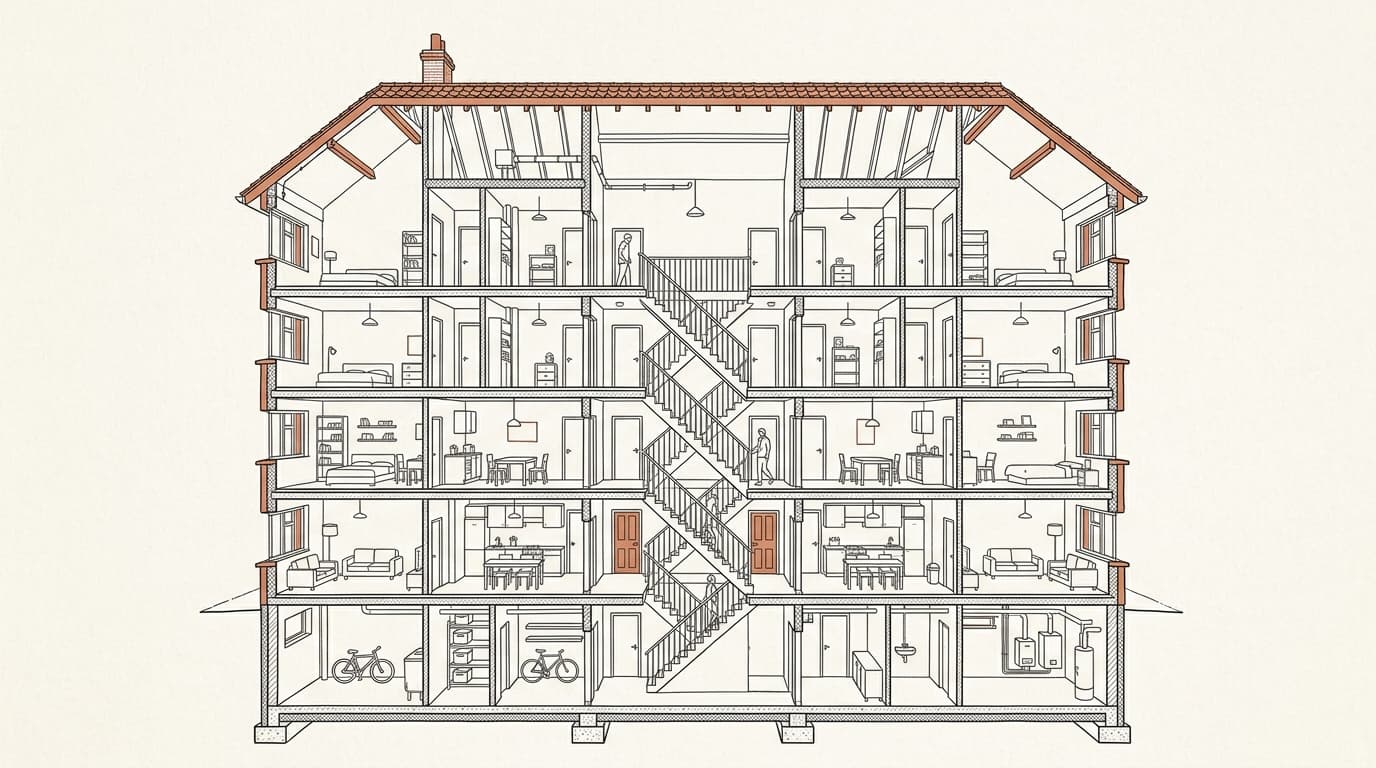
The first level is the law. Its provisions are mandatory (Article 3.100): a clause in the articles that contradicts it is automatically replaced by the legal rule. In practice, the three-quarters majority in your old articles no longer applies where the Civil Code now provides for two thirds. Our advice: when a building document and the Civil Code contradict each other, always start from the Civil Code.
The second level is the articlesGlossaryThe deed of division and the co-ownership regulations taken together. They must be drawn up by authentic (notarial) deed, as must any amendment to them, and transcribed to be enforceable against third parties. See the glossary, that is, the deed of division and the co-ownership regulations. They are executed before a notary and registered. They describe the building and set the shares (quotités)GlossaryFraction of the common parts attached to each unit, set in the deed of division according to the respective value of the private parts. Shares determine the number of votes at the general meeting and can only be changed with the unanimous agreement of all co-owners. See the glossary and the split of charges. Everything is set out in deed of division and co-ownership regulations.
The third level is the house rules (ROI), drawn up by private agreement. They organise the general meeting, the appointment of the syndic and life together.
Then come the decisions of the general meeting, recorded in a register. They bind the co-owners and, subject to their being communicated, the tenants and other occupants.
Who applies these rules?
The owners' association (VME/ACP)GlossaryLegal entity that brings the co-owners together and whose sole purpose is the preservation and management of the building. It acquires legal personality as soon as a first unit is transferred, provided the deed of division and the co-ownership regulations have been transcribed. See the glossary is the legal entity that manages and maintains the building. French speakers often wrongly call it ‘syndicat des propriétaires’: owners' association (VME) explains why. It acts through its bodies: the general meeting, the syndic, the co-ownership council in buildings with at least twenty units (excluding cellars, garages and parking spaces) and the accounts auditor.
Each co-owner keeps rights of his own: consulting the documents, having an item put on the agenda, challenging a decision. Co-owners' rights and obligations goes through them, and private and common parts helps you work out who pays for what.
When dialogue fails, the justice of the peace is the only competent court at first instance. An arbitration clause in the articles is deemed unwritten.
Flanders and Brussels: same law, different context
The Civil Code is federal: majorities, deadlines and bodies are identical in all regions. The differences lie elsewhere. Works that alter the façade fall under the Brussels Spatial Planning Code (CoBAT/BWRO) in Brussels and under the Flemish spatial planning rules in Flanders: check with your municipality which permit you need. Renovation grants and energy obligations vary from one region to another. In the bilingual Brussels-Capital Region, a co-owner can obtain, at the association's expense, a translation of the co-ownership documents into one of the region's languages (Article 3.96).
For the specialist vocabulary, the co-ownership glossary gives a short definition of each term, with the Civil Code article where there is one.
Frequently asked questions
Is co-ownership law the same in Flanders and in Brussels?
Yes. The co-ownership regime is set out in the Civil Code, which is a federal law. The regions act in other areas that affect the building, such as spatial planning, energy performance or renovation grants.
Do the former Articles 577-2 et seq. of the Civil Code still apply?
Their content has been carried over into Book 3 of the Civil Code, which came into force on 1 September 2021. Articles 3.78 to 3.100 are now cited, but many articles of association and older judgments still refer to the old numbering.
My articles date from before 2019: are they still valid?
Yes, but the provisions of the chapter on co-ownership are mandatory. A clause contrary to the law is automatically replaced by the corresponding legal rule, without a notarial amendment being needed for the law to apply.
Does an arbitration clause in the articles prevent you from going to court?
No. The Civil Code deems unwritten any clause that gives one or more arbitrators the power to settle disputes about the application of the chapter on co-ownership.