Works in your apartment: when the GM must vote
In your private unit, you renovate without asking anyone's opinion. As soon as the works touch a load-bearing wall, the facade or a common pipe, you need a two-thirds vote of the general meeting, obtained before the first sledgehammer blow. Here is how to tell, and how to prepare the request.
Contents of this post
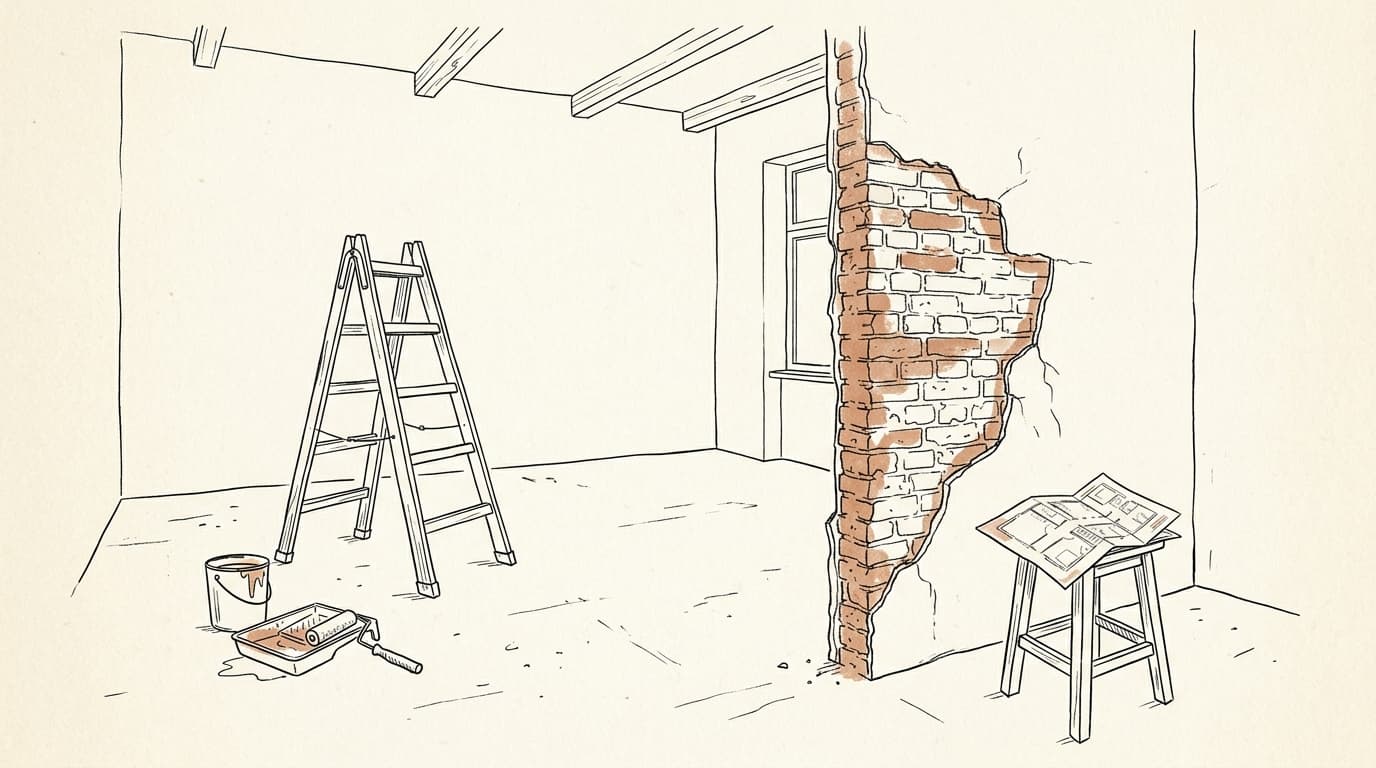
You have bought an apartment that needs freshening up, or you have lived in yours for fifteen years and the closed-off kitchen is getting to you. The contractor is free in March. One question remains open before you sign anything: do you need the co-ownership's consent?
Often, no. Sometimes, yes, and in that case the order of the steps matters as much as the works themselves. Here is how to decide, then how to get the authorisation without losing a season.
Do your works touch a common part?
Everything starts there. Inside your private partsGlossaryParts of the building that belong exclusively to the owner of a unit, such as the interior of an apartment. They are described in the deed of division. See the glossary, you act as an owner: painting, changing the floor, redoing the bathroom, moving a light partition. No vote is required. As soon as the works touch a common partGlossaryParts of the building or land that belong to all co-owners according to their shares, such as the roof, the entrance hall or shared pipes. Where the title deeds are silent or contradictory, parts intended for the use of all or some co-owners are deemed common. See the glossary, the decision belongs to the general meeting (GM).
The boundary itself varies from building to building. It is the deed of division (acte de base / basisakte) that describes the private parts and the common parts of your building (Art. 3.85, § 1, of the Civil Code). When it is silent or contradicts itself, the law leans towards the common: parts of buildings intended for the use of all the co-owners or of some of them are deemed common (Art. 3.84). A wall that carries the floors above serves the whole building. It is presumed common, even if it runs through your living room.
The table covers the most frequent cases. It does not replace reading your by-lawsGlossaryThe deed of division and the co-ownership regulations taken together. They must be drawn up by authentic (notarial) deed, as must any amendment to them, and transcribed to be enforceable against third parties. See the glossary, which may decide otherwise.
| Your works | Usual classification | What you need to obtain |
|---|---|---|
| Painting, floors, kitchen, bathroom | Private | Nothing, apart from the house rules (hours, acoustics) |
| Knocking down a non-load-bearing partition | Private | Nothing, after having checked that it is not load-bearing |
| Opening or removing a load-bearing wall | Common (structural work) | Two-thirds vote, and often a planning permit |
| Replacing windows in the facade | Varies according to the by-laws | Read the by-laws, vote if common or if the look changes |
| Drilling through the facade (flue, air conditioning) | Common | Two-thirds vote |
| Working on a common riser or drain | Common up to the branch towards the unit | Vote, and work coordinated with the syndic |
| Running a cable or duct through the common areas | Common | Notification by registered post (Art. 3.82) |
Borderline cases, terraces and balconies included, are dealt with on the page on private and common parts.
What majority is needed to authorise your works?
Works affecting the common parts are decided by a two-thirds majorityGlossaryMajority required in particular for works affecting the common parts, other than works required by law and protective works, and for amendments to the articles that concern only the enjoyment, use or management of the common parts. See the glossary of the votes (Art. 3.88, § 1, 1°, b)). That is the threshold that applies when you ask to open a load-bearing wall or drill through the facade, even if the owners' association (VME/ACP) does not spend a cent.
Two kinds of project go further. Reserving the use of a common part for yourself, for example the end of the corridor outside your door, amends the by-laws: two-thirds if the amendment concerns only enjoyment or use (Art. 3.88, § 1, 1°, a)), four-fifths for buying that corridor or merging two units, with a notarial deed to follow. How to count votes and abstentions is explained on the page on voting rules and majorities.
How do you get the general meeting's consent, step by step?
Take a hypothetical example, built for illustration: an apartment on the third floor of a ten-unit building in Ixelles. The owner wants to open the kitchen onto the living room, which means breaking through a load-bearing wall, and to replace her wooden windows. The house rules set the ordinary general meeting in the first half of May.
- Read the by-laws before calling the contractor. Look for the wall and the windows in the deed of division, then for the charges rule in the co-ownership regulations. In our example, the wall is part of the common structure; the windows are private, but the regulations impose a uniform model on the facade.
- Have the wall assessed by a professional. A structural engineer or an architect will say whether it is load-bearing and what opening it requires. Without that note, the general meeting is voting blind, and it is right to refuse.
- Check with the municipality. Touching the structure or altering a facade may require a permit: in Brussels, as in our example, a planning permit under the Brussels Spatial Planning Code (CoBAT / BWRO); in Flanders, an environmental permit for planning works (omgevingsvergunning voor stedenbouwkundige handelingen), which is in principle needed for any intervention with a spatial impact, while some smaller interventions are exempt or only need to be notified. The Flemish government advises checking this before the works start and always asking the municipality, because local rules can be stricter (Vlaanderen.be, environmental permit for planning works). The general meeting's vote does not exempt you from this.
- Send the request for an agenda item in time. Your written proposal must reach the syndic at least three weeks before the first day of the ordinary general meeting period (Art. 3.87, § 3). In the example: by 10 April at the latest. If it arrives later, it goes to the following meeting (Art. 3.87, § 4).
- Draft a proposed decision, not a wish. For example: “Authorisation granted to the owner of unit 6 to open the load-bearing wall between kitchen and living room, at her own expense, in accordance with the attached structural study, under the supervision of an architect, with insurance covering damage to the common parts.”
- Wait for the minutes. The syndic sends out the decisions within thirty days of the meeting (Art. 3.87, § 12). Start when you have the text in hand, not on the strength of a show of hands that nobody remembers in the same way.
Attach to the request everything that lets the meeting vote without coming back to you:
- the plan of the apartment, with the works area marked;
- the engineer's or architect's note;
- the description and schedule of the works, hours included;
- the contractor's insurance certificate;
- for windows, the planned model, colour and dimensions.
In the example, the timetable looks like this:
| Step | Deadline set by the Civil Code | In the example |
|---|---|---|
| Request for an agenda item to the syndic | Received three weeks before the start of the period (Art. 3.87, § 3) | By 10 April at the latest |
| Notice of meeting | Sent at least fifteen days before the meeting, except in an emergency | By 16 April at the latest for a meeting on 1 May |
| Minutes of the decisions | Sent within thirty days (Art. 3.87, § 12) | By 31 May at the latest |
| Challenge by a co-owner | Four months from the general meeting (Art. 3.92, § 3) | Until 1 September |
That last deadline deserves a word. A neighbour who considers the decision irregular or unfair can challenge it for four months. We are not saying you must wait until September to open the wall. But a clean technical file, attached to the notice of meeting, reduces that risk far more than any precaution taken afterwards.
The general meeting refuses without reason: the justice of the peace can authorise you
A refusal is not always the end of the story. Any co-owner can obtain authorisation from the court to carry out, at their own expense, works that are useful to them, even if they affect the common parts, when the general meeting opposes them without legitimate reason (Art. 3.92, § 5). The consolidated text published by the Professional Institute of Estate Agents (BIV/IPI) lets you reread this article in context.
Everything hinges on the words “without legitimate reason”. A refusal based on the stability of the building, on a facade whose uniformity is protected by the by-laws or on a real nuisance for the neighbours stands every chance of holding. A refusal on principle, without looking at the file, much less so. Our reading: the technical file you presented to the general meeting will also be your best document before the judge, because it shows that every objection could be dealt with.
This route requires a prior court decision. Not works that are started and then regularised.
What do you risk by starting without authorisation?
Nothing stops you on day one. The risk comes later: the association can ask the court to have the common parts restored to their original state, and any damage caused to the structure or to the neighbouring apartments remains your responsibility. A load-bearing wall opened without a study is also a safety issue for the whole building. We advise against it without reservation.
Cables and ducts: a procedure by registered post
Running a cable, pipe or duct through the common parts, for energy, water or telecommunications, follows its own rule (Art. 3.82). The co-owner who wants to install such equipment at their own expense announces it by registered post at least two months before the works start, describing the works and what they improve. The other co-owners or the association can object by registered post within two months of receipt, citing a legitimate interest: infrastructure already in place, serious harm to the appearance, use or safety of the building, a financial burden for the others. The works are then carried out with as little disturbance as possible.
If your project ties in with works decided by the association, such as replacing all the windows on the facade, the page on building works takes over. And for working hours, protecting the lift or removing rubble, reread your house rules (ROI): that is often where neighbour disputes start, long before any question of majorities.
Frequently asked questions
Do I need to tell the syndic about purely private works?
No authorisation is required, but the house rules may set working hours, soundproofing rules or the protection of the lift and entrance hall. Telling the syndic before the workers arrive avoids most conflicts with the neighbours.
Can a single neighbour block my works?
Only if their votes are enough to prevent the two-thirds majority. A co-owner who voted against can, however, ask the justice of the peace to annul the decision if it causes them personal harm, within four months of the general meeting (Art. 3.92, § 3).
Who pays for the structural study and for restoring the common parts?
When the general meeting authorises works carried out solely in your interest, the decision usually provides that they are at your expense, studies and restoration included. Have it written in black and white in the proposal put to the vote, together with the insurance covering any damage.
Can I replace my windows without a vote if the by-laws say they are private?
Often yes, but the co-ownership regulations frequently impose a uniform model and colour on the facade. A window that changes the look of the building then comes back to the general meeting, and a permit may be needed; always check with your municipality.
Can my tenant ask for authorisation in my place?
No. The right to have an item put on the agenda belongs to the co-owners and to the co-ownership council (Art. 3.87, § 4). The tenant goes through their landlord, who submits the request and remains responsible for the works towards the association.