The co-owners’ general meeting: preparing, voting, challenging
A notice of meeting has just arrived, a vote seems dubious to you, or it is your turn to organise the next meeting. Here we follow a meeting from start to finish, with the Civil Code rules that apply in Flanders and in Brussels alike.
Pages in this topic
Updated on 25.09.2026- Organise a general meeting: preparing your GM without missing a deadline
The ordinary meeting is approaching and it is up to you to prepare it, or you want an item voted on. Here is the timetable to work back from and the practical choices to make, from the house rules to the day of the meeting.
- General meeting notice: drafting it, sending it and checking it
The notice has just arrived, or you are the one who has to send it. Deadline, method of sending, mandatory content, items requested by co-owners: here is what the Civil Code requires, and how to check in ten minutes that yours holds up.
- General meeting minutes: drafting them, getting them signed and sending them out
The minutes of the last general meeting have just arrived, or it is up to you to draft them during the meeting. Here is what they must contain, who signs them, how soon you should receive them and what to check when you read them.
- General meeting majorities: counting the votes without making mistakes
The vote is coming up, or the result announced at the meeting looks wrong to you. Quorum, absolute majority, two thirds, four fifths or unanimity: here is which threshold applies to which decision, how to count the votes and where the proxy pitfalls lie.
- Challenge a general meeting decision: identify the grievance and go to the justice of the peace
The minutes have arrived and a decision strikes you as irregular or unfair. You can ask the justice of the peace to annul or amend it, provided you act within four months of the meeting and show personal harm.
- Co-ownership council: setting it up, appointing its members and overseeing the syndic
You have just been elected to the co-ownership council, or the meeting is wondering whether to set one up. Here is when it is compulsory, who can sit on it, what it can demand from the syndic and where its role ends, alongside the accounts auditor.
A registered letter from the syndic, a packed agenda, quotes attached: the general meeting rarely arrives at a moment when you have time to get stuck into it. Yet that is where everything concerning your building is decided, from the year’s budget to the roof works.
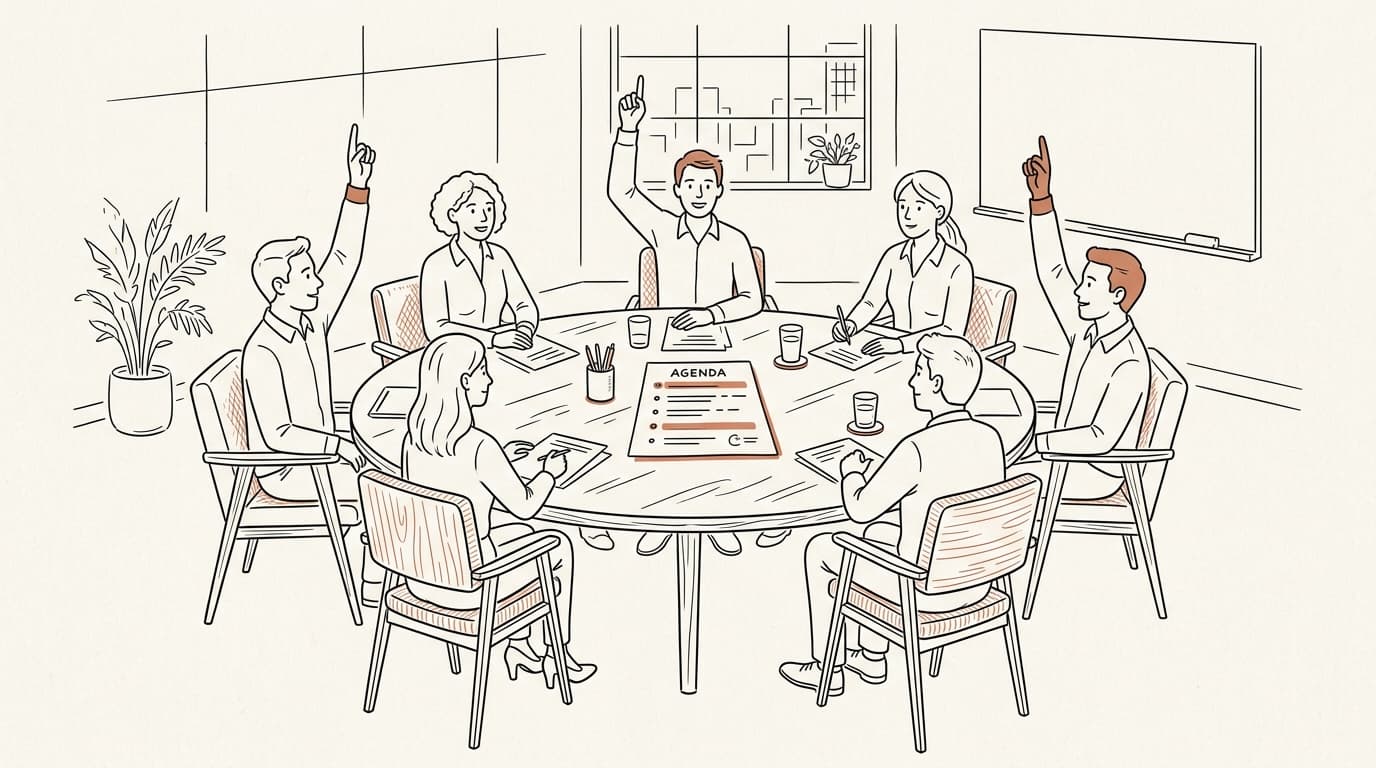
In an apartment building, no shared decision is taken in the corridor. It is taken at the co-owners’ general meeting (GM), which brings together all the co-owners and is the decision-making body of the owners’ association (VME/ACP)GlossaryLegal entity that brings the co-owners together and whose sole purpose is the preservation and management of the building. It acquires legal personality as soon as a first unit is transferred, provided the deed of division and the co-ownership regulations have been transcribed. See the glossary. The syndic (the building’s property manager) carries out, the co-ownership council oversees, the accounts auditor checks. But it is the meeting that approves the budget, chooses the syndic, decides on works and, when necessary, changes the building’s rules.
The rules are set by the Civil Code, Book 3, in articles 3.84 to 3.100. They are the same in Flanders and in Brussels. Your building’s house rules (reglement van interne orde / règlement d’ordre intérieur)GlossaryRules drawn up by private agreement that set out at least how the general meeting operates, how the syndic is appointed and the fortnight in which the ordinary general meeting is held. They are kept at the association's registered office and can be consulted free of charge. See the glossary supplement these rules on practical points, such as the period of the ordinary meeting, without being able to fall below the safeguards of the law.
A general meeting unfolds in four stages
It all starts with the preparation. Each year the syndic holds an ordinary meeting during the fifteen-day period set by the house rules. Co-owners who together hold at least one fifth of the shares in the common parts can demand another one. The page on organising a general meeting details the timeline, the agenda and remote participation.
Next comes the notice of meeting. It goes out at least fifteen days before the meeting, except in an emergency, by registered mail or by another means the co-owner has accepted in writing. Its form and content are explained in the page on the general meeting notice.
On the day itself, the session opens by checking the quorum, then each item is voted on. Depending on the decision, an absolute majority, two thirds, four fifths or unanimity is required. The thresholds, proxies and the cap on votes are brought together in the page on voting rules and majorities.
Finally, the syndic draws up the minutes, has them signed at the end of the session, enters them in the register and sends them out within thirty days. The page on general meeting minutes sets out what they must contain.

What to do if a decision seems irregular to you?
A co-owner can ask the justice of the peace (vrederechter / juge de paix) to annul or amend an irregular, fraudulent or abusive decision that causes them personal harm. The time limit is four months from the date of the meeting. The same article also allows you to go to the court when a minority is abusively blocking a decision. The steps are in the page on challenging a GM decision.
Before it comes to that, reread the minutes and the notice of meeting. Many disagreements are settled by putting the item on the agenda of the next meeting.
Let us say it straight away: the timeline is not up for discussion. The four months run from the date of the meeting, and the minutes can arrive up to thirty days later. An amicable discussion that drags on does not suspend the time limit.
Why your attendance counts, even in a small building
Each co-owner votes in proportion to their shares in the common partsGlossaryTerm used by the Civil Code for the fraction of the common parts attached to each unit, also called quotités. It is set in the deed of division according to the respective value of the private parts and determines each co-owner's number of votes at the general meeting. See the glossary. Being absent does not just deprive you of a say: it can prevent the quorum from being reached and force a second meeting to be called, at least fifteen days later. If you cannot come, the law allows you to give a proxy to anyone you choose, except the syndic, and remote participation is possible when the notice of meeting provides for it.
Your vote is also a protection. The minutes must state the names of the co-owners who voted against or abstained. If you disagree with a decision, vote against or abstain rather than staying silent. Our reading: a co-owner who is absent without a proxy lets the others decide in their place on expenses they will then share.
Who supervises the syndic between two meetings?
In buildings with at least twenty units, not counting cellars, garages and parking spaces, a co-ownership council must be set up. It oversees the proper performance of the syndic’s duties and presents an annual report to the ordinary meeting. In smaller buildings, the meeting can create one if it wishes. Each year the meeting also appoints an accounts auditor, who may or may not be a co-owner. The page on the co-ownership council sets out the composition, powers and limits of these two roles.
For the role of the syndic themselves, see the page on the syndic. Questions of budget and statements voted at the meeting are covered in co-ownership service charges.
Frequently asked questions
Is the general meeting compulsory every year?
Yes. The syndic holds a general meeting during the period set by the house rules, which provide for an annual fifteen-day period for the ordinary meeting (arts 3.85 and 3.87, § 2, Civil Code). Other meetings can be called during the year.
Can a tenant attend the general meeting?
No, they do not vote there. The syndic must, however, tell occupiers who have no voting rights the date of the meetings, so that they can put their requests or comments in writing (art. 3.89, § 5, Civil Code).
How long do I have to challenge a decision?
Four months from the date of the general meeting, before the justice of the peace (art. 3.92, § 3, Civil Code). After that period, an action for annulment is no longer admissible.
Are the rules different in Flanders and in Brussels?
No. How the general meeting works is governed by the Civil Code, which is a federal law. The regions act in other areas, such as renovation grants or energy obligations.