Acte de base and co-ownership regulations: reading and amending them
In the file the notary gave you, a deed of division and co-ownership regulations decide your shares, your votes and your charges. Here is how to read them, and how they are changed.
Contents of this page
- Get the articles of co-ownershipAsk the syndic or the notary for a full copy of the deed of division, the co-ownership regulations and every amending deed.
- Find your unitLook up the description of your private part and its share in the common parts.
- Read how charges are splitCheck the criteria and calculation method the co-ownership regulations set for each type of charge.
- Prepare an amendmentHave the proposal put on the agenda with the proposed wording, then have the decision recorded by a notary.
- Have it registeredCheck that the amending deed has been registered, otherwise it cannot be relied on against third parties.
A service charge statement seems unfair to you. A neighbour wants to enclose their terrace. The meeting is considering selling a shared cellar. In all three cases, someone eventually says: ‘We need to look at the acte de base.’ So you dig out the notary’s file again, and you come across a dense text full of thousandths and unit numbers that you never really read when you bought.
Yet it is the document that brings the co-ownership into legal existence. Drawn up by a notary, often at the request of the developer or of the owner who divides up a building, the deed of division (acte de base / basisakte) describes what belongs to each owner and what belongs to everyone. It almost always comes with the co-ownership regulations, and the Civil Code calls these two texts together the articles of co-ownershipGlossaryThe deed of division and the co-ownership regulations taken together. They must be drawn up by authentic (notarial) deed, as must any amendment to them, and transcribed to be enforceable against third parties. See the glossary of the building. But they are not the last word. They sit within the legal framework of co-ownership set by the Civil Code, which takes precedence over them.
Acte de base, co-ownership regulations, house rules: three separate texts
The Civil Code requires three documents for every building under the co-ownership regime (Article 3.84): a deed of division, co-ownership regulations and house rules (ROI / RIO). The first two are notarial deeds. The third is not.
| Document | Form | Essential content | Amendment |
|---|---|---|---|
| Deed of division | Authentic deed, registered | Description of the whole, of the private and common parts, share of each unit | General meeting, then notary |
| Co-ownership regulations | Authentic deed, registered | Rights and obligations, allocation of charges, penalties for non-payment | General meeting, then notary |
| House rules | Private agreement | How the meeting works, appointment of the syndic, period of the ordinary GM | General meeting, without a notary |
In practice, the deed of division and the co-ownership regulations are often combined in a single notarial deed. The house rules have their own page: house rules.
“The deed of division and the co-ownership regulations, which constitute the articles of the building or group of buildings, as well as any amendment made to them, must be the subject of an authentic deed.”Art. 3.85, § 1, Civil Code
What does the acte de base contain?
Article 3.85, § 1, sets out its minimum content.
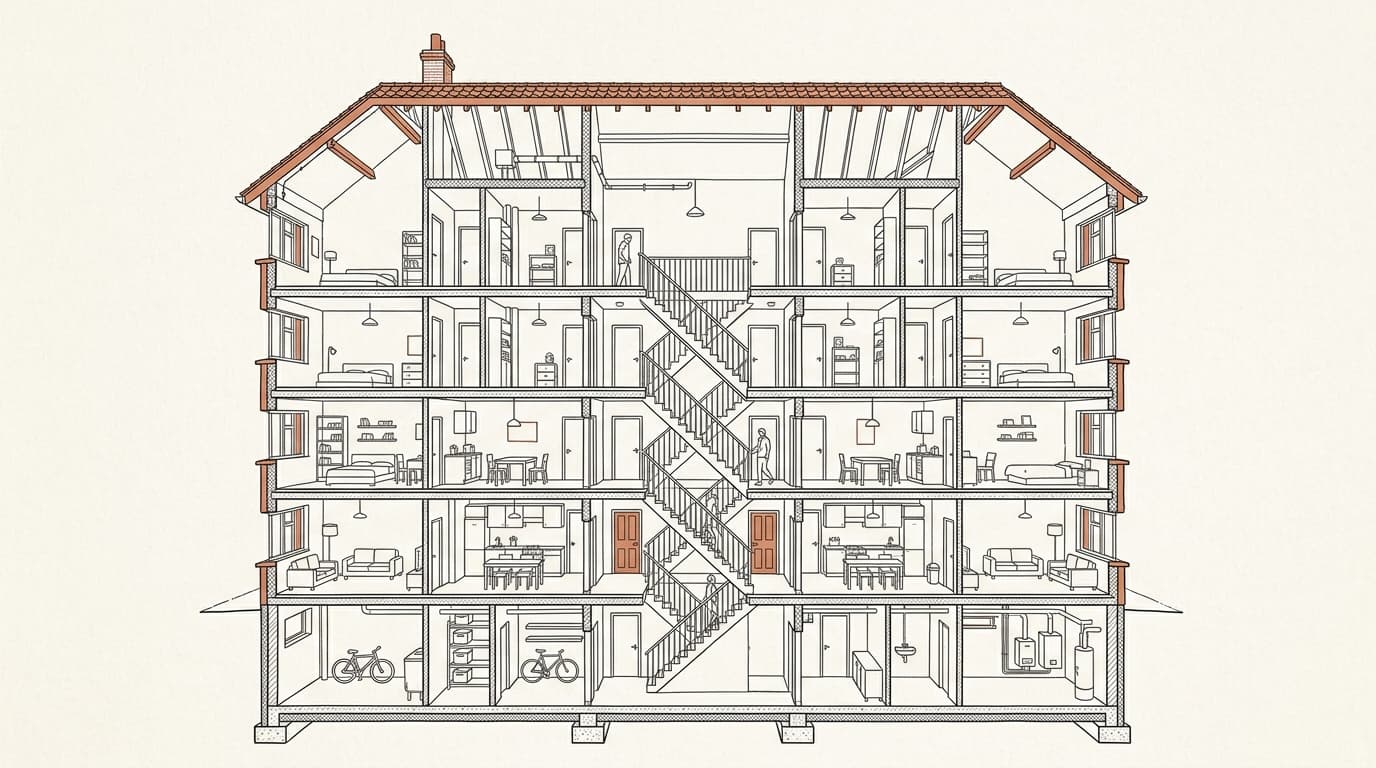
First you find the description of the property as a whole: the plot, the building or buildings, their floors. Then come the private parts, unit by unit (a third-floor apartment with cellar number 12, for example), and the common parts.
The heart of the deed is setting the share of the common parts attached to each private part. These shares (quotités)GlossaryFraction of the common parts attached to each unit, set in the deed of division according to the respective value of the private parts. Shares determine the number of votes at the general meeting and can only be changed with the unanimous agreement of all co-owners. See the glossary, often expressed in thousandths or ten-thousandths, are not chosen freely. The law requires account to be taken of the respective value of the units, determined on the basis of three criteria: net floor area, use and location of the private part. The calculation rests on a reasoned report drawn up by a notary, a surveyor, an architect or an estate agent.
Why does this matter to you? Because the share determines your number of votes at the general meeting (Article 3.87, § 6) and often serves as the basis for allocating charges. In practice, it is the first figure to look for in the deed, even before the description of your apartment.
Older deeds do not always have that reasoned report, and some shares were set according to other logics. If that is the case in your building and the gap has become obvious, for example after a shared attic was converted into an apartment, the route open to you is an action for correction before the court (Article 3.92, § 7), explained in the page on justice of the peace and co-ownership disputes.
What do the co-ownership regulations contain?
The co-ownership regulations have at least two parts.
The first describes each co-owner’s rights and obligations regarding the private parts and the common parts. This is where you will find, depending on the building, the ban on changing the appearance of the façades without permission, the rules on professional activities in an apartment, or the exclusive use of a shared garden.
The second part is about money: the reasoned criteria and the method for calculating the allocation of charges, and where applicable the clauses and penalties for non-payment. An allocation keyGlossaryCalculation rule that determines each unit's share of a category of charges: shares, metered consumption or another reasoned criterion. The criteria and the calculation method are set out in the co-ownership regulations. See the glossary may follow the shares for most expenses and use a different logic for the lift, which the ground floor does not benefit from, or for heating, split according to meters.
The co-ownership regulations cannot provide for everything. Two clauses are deemed unwritten by Article 3.85: one that limits your right to entrust the management of your unit to the person of your choice, and one that refers co-ownership disputes to arbitrators.
How do you amend the acte de base, and by what majority?
The procedure always follows the same path: a decision of the general meeting by the right majority, then a notarial deed, then registration. The majority depends on what is being changed (Article 3.88).
| Amendment sought | Required majority |
|---|---|
| Articles, provided the amendment concerns only the enjoyment, use or management of the common parts | Two thirds of the votes |
| Any other amendment to the articles, including the allocation of charges | Four fifths of the votes |
| Change of use of the building or part of it | Four fifths of the votes |
| Dividing a unit or merging several units | Four fifths of the votes |
| Distribution of the co-ownership shares | Unanimity of all co-owners |
Majorities are calculated on the votes of the co-owners present or represented, not counting abstentions and blank or spoilt votes. Quorums and the calculation are set out in detail in the page on voting rules and majorities.
The unanimity required to touch the shares means all co-owners, not just those present. If it fails only because some are absent, the law provides for a new general meeting after a period of at least thirty days (Article 3.88, § 4).
The developer before provisional acceptance
As long as the common parts have not been provisionally accepted, those who signed the original articles can still amend them without a vote, provided this is justified by technical reasons or by the legitimate interest of the association, does not affect the rights of the other co-owners and does not increase their obligations. They bear the costs and must notify each co-owner by registered post at least two months before the amending deed is signed (Article 3.85, § 2).
Why registration changes everything
Signing at the notary’s is not enough. The articles and their amendments must be registered in the registers of the competent office of the General Administration of Patrimonial Documentation, which notaries call the Legal Certainty office.
This formality has two effects. On the one hand, it makes the articles enforceable against third parties. On the other, it determines the legal personality of the association: the owners’ association (VME/ACP) acquires legal personality only once joint ownership has arisen and the deed of division and co-ownership regulations have been registered (Article 3.86, § 1). As long as registration is missing, the association cannot rely on its legal personality against third parties, whereas they can invoke it against the association. The page on the owners’ association (VME/ACP) goes into this point.
The most common reading mistakes
First trap: believing that a decision of the meeting is enough. An amendment to the articles that was voted but never executed before a notary remains fragile, especially towards a buyer who never received it. Our view: a vote that affects the articles is only complete on the day the amending deed is registered, and you need to follow the file until then.
Second trap: reading the acte de base without its amending deeds. A unit divided in 2008, a cellar sold in 2015: each change was the subject of a separate deed. Ask the property manager (syndic) for the complete list.
Third trap: treating the description of the common parts as exhaustive. Where titles are absent or contradictory, the law deems common the parts of buildings or land intended for the use of all co-owners or some of them (Article 3.84). The page on private and common parts explains how to settle borderline cases such as window frames, balconies or pipes.
Last trap, for buyers: signing a sale agreement without having read the articles. You will be bound by them as soon as you become a co-owner. We advise nobody to buy an apartment without first looking up the unit’s share, its charge key and its restrictions on use. The documents to ask for before signing are listed in the page on documents required for a sale.
Do, avoid
- Keep a copy of the articles and of every amending deed
- Compare the allocation key in the regulations with the statement you received
- Attach the draft wording to the notice when an amendment is proposed
- Have old clauses checked against the current Civil Code
- Confusing the co-ownership regulations with the house rules
- Applying a clause that breaches the law just because it is in the deed
- Changing the shares by a simple majority vote
- Forgetting registration after signing at the notary’s
Frequently asked questions
Who pays for amending the articles of co-ownership?
In principle, the owners’ association, since the general meeting decides on the amendment. The law provides an exception: when those who signed the original articles, often the developer, amend them before the provisional acceptance of the common parts, they bear the costs.
Can the acte de base be amended without a notary?
No. Article 3.85, § 1, of the Civil Code requires the articles and any amendment to them to be made by authentic deed. Only the house rules can be drawn up and amended by private agreement.
What if the shares were miscalculated from the start?
Any co-owner can ask the court to correct the distribution of shares or the method for allocating charges if they were calculated incorrectly or have become incorrect as a result of changes to the building (Article 3.92, § 7).
Where can I find my building’s acte de base?
The syndic must keep it and make it available to co-owners. It is also in the file you received when you bought, and you can ask for it from the notary who drew it up or from the Legal Certainty office (Rechtszekerheid / Sécurité juridique) where it was registered.
- Banning Airbnb in your co-ownership: is it possible?
Yes, but not through a simple clause in the house rules. A Belgian co-ownership can ban or regulate holiday letting by amending its articles, by a four-fifths majority of the votes and before a notary. In Brussels, a co-owner cannot register anyway without the written consent of the general meeting.
- Balcony: common or private part? Four answers
A balcony is neither common nor private by nature: in Belgium, the Civil Code does not classify it, your articles decide, element by element. Slab, waterproofing, surface and railing can have four different statuses. If the articles are silent, the element is presumed to be common.