Water damage in a co-ownership: the building or you?
Most of the time, two contracts each pay their share. The building policy, taken out by the syndic, covers the damaged structure if it includes water damage cover; your home insurance covers your contents. Repairing the leak follows a third logic: that of the part involved, common or private.
Contents of this post
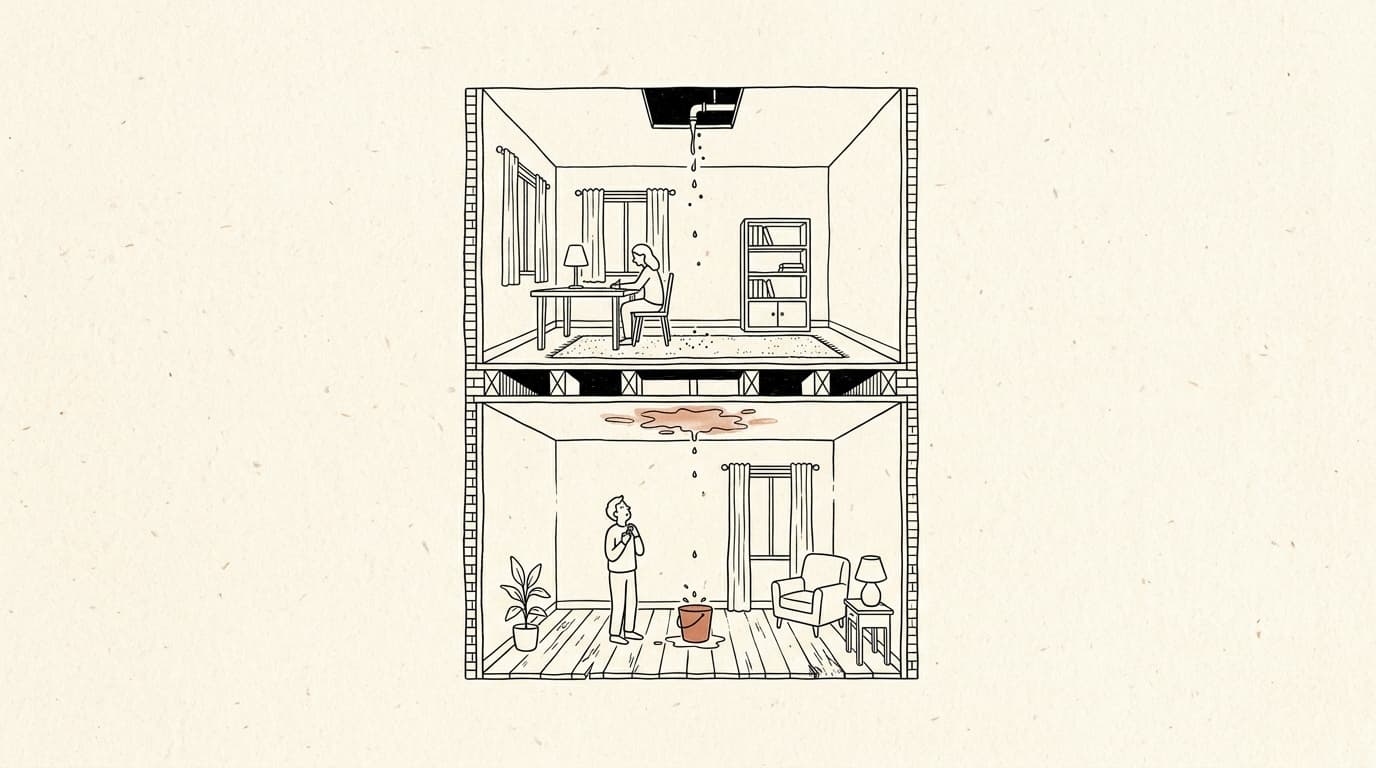
The living room ceiling swelled up overnight. A drop falls into the basin every ten seconds, the upstairs neighbour is not answering, and the syndic, reached by phone, tells you to "make a claim". But with whom? Your insurer, the building's insurer, the neighbour's?
Let us say it straight away: in most cases of water damage in a co-ownership, there is not one payer but three. The building policy, your home insurance, and the owners' association (VME/ACP) funds or the owner of a unit for repairing the leak itself. Setting them side by side, item by item, avoids half the arguments. The technical steps (shut off, locate, get it repaired) are described on the page on water damage and leaks; here, we are talking about who pays for what.
Three payers for a single leak
Let us take a typical case, built for the example. A building with six apartments in Schaerbeek. A common supply pipe, embedded in the wall on the third floor, springs a leak. The water runs down into the second-floor co-owner's flat: stained ceiling, plaster to redo, paintwork ruined, and the sofa of the tenant who lives in the apartment is soaked.
This single leak gives rise to three separate expenses.
- Replacing the leaking section of pipe. This is a common part: the association pays, as a common charge.
- Redoing the ceiling and paintwork on the second floor. This is structure: the building policy steps in, if it includes water damage cover and if its definition covers a burst pipe.
- Drying or replacing the sofa. This is contents: the tenant's home insurance pays, the building policy almost never.
Change a single parameter, and everything shifts. If the leak comes from a washing machine hose on the third floor, the repair becomes the business of that unit's owner, and the insurer that compensated the second floor can turn to them. The status of the part involved therefore decides what happens next. Where the title deeds are silent or contradictory, parts intended for the use of all the co-owners or some of them are deemed common partsGlossaryParts of the building or land that belong to all co-owners according to their shares, such as the roof, the entrance hall or shared pipes. Where the title deeds are silent or contradictory, parts intended for the use of all or some co-owners are deemed common. See the glossary (art. 3.84, Civil Code); the actual boundary, pipe by pipe, is set out in the deed of division (acte de base / basisakte) and explained on the page on private and common parts.

Building policy or home insurance: item by item
The two contracts do not compete. They complement each other, and each has its blind spots.
| Criterion | Building policy | Home insurance of the co-owner or occupant |
|---|---|---|
| Who takes it out | The syndic, on behalf of the association, by decision of the meeting | Each co-owner, or the tenant for their home |
| Who pays the premium | All the co-owners, as a common charge | The policyholder |
| Property covered | The structure: common parts, and often private parts | The contents, and the structure if the building is not insured as a whole |
| Water damage cover | A frequent extension, never automatic | To be checked in the contract, definition included |
| Furniture, appliances, personal belongings | Generally excluded | Covered, depending on the cover taken out |
| Liability towards a neighbour | Third-party recourse, for damage originating in the common parts | Civil liability, for damage originating in your home |
| Who reports the claim | The syndic | The policyholder |
| Repairing the leak itself | No, unless there is a special clause | No, unless there is a special clause |
Two rows need explaining.
Water damage cover is not automatic in a building policy. Fire insurance automatically covers fire, lightning, explosion and a few other perils, and for simple risks the law adds storm and natural disasters. Water leaking from a pipe is not one of them: the FPS Economy classes it among the extensions, alongside glass breakage and electrical damage. Most building policies include it. Not all, and not always in the same terms: a contract may cover a burst pipe and exclude seepage through the roof, two problems that look very alike from below.
The contents, however, almost always remain your responsibility. A comprehensive policy can cover the private parts, that is the walls, ceilings and floors of your apartment. The sofa, the books, the laptop on the floor are generally not included. Improvements (parquet flooring, a fitted kitchen, paintwork) sit on the borderline, and it is the definition of the insured property in the contract that decides, not common sense. The page on co-ownership insurance explains how to read this clause.
Who reports the claim, and to which insurer?
Each to their own. The syndic reports to the building's insurer, because they represent the association and carry out protective measuresGlossaryMeasures intended to protect the building or the rights of the association without waiting for a decision of the general meeting, such as a temporary repair after an insured loss. The syndic is responsible for carrying them out. See the glossary (art. 3.89, § 5, 2° and 4°, Civil Code). You report to your own insurer whatever falls under your contract. The tenant reports to hers.
In practice, that often means two or three claims for a single event, and that is normal. What is not normal is waiting for the other party to report before you act. Notify the syndic of the damage in writing the same day, with dated photos: that letter opens the file on the building's side and dates your observation.
A piece of advice we keep repeating: in the claim, describe the facts, not who is liable. "Water on the living room ceiling since the night of the 14th, coming from the floor above" is better than "leak from the common pipe, the association's liability". The assessment may reveal a different origin, and a description given too early complicates recourse.
If the syndic is slow, you can obtain the policy itself. The syndic must give the co-owners access to all the non-private documents of the co-ownership (art. 3.89, § 5, 9°): ask for the special and general conditions, not just the certificate, since it is the definition of the peril that will say whether your ceiling is covered.
The leak is before the meter: a fourth party?
Sometimes, yes. When water comes out in the cellar near the meter, you need to know which side it is on. In Brussels, Vivaqua sets the boundary clearly: the water company manages the installation up to the meter and the meter itself, except for the seal fitted after it; beyond that, the installation is the owner's responsibility (Vivaqua, water leak in the cellar). A leak before the meter is therefore reported to the water company, not to the building's insurer. In Flanders, check the split with the drinking water company that serves the building.
Tenant upstairs, tenant downstairs: who insures what?
Co-owners who let their unit have one more check to make, and it depends on the Region.
In Flanders, for residential leases concluded from 1 January 2019, the tenant must insure their liability; they can do so with their own policy or through a waiver of recourse in the landlord's insurance, as Wonen-Vlaanderen explains the Flemish Residential Tenancy Decree. In Brussels, the obligation to have home insurance rests on the tenant for leases concluded or renewed since 1 November 2024; the parties may agree to exempt the tenant, in which case the landlord has a waiver of recourse clause included in their own contract. Wikifin summarises these rules.
For the association, this changes little. For you, a great deal. If the damage starts in a let apartment whose tenant is not insured, the co-owner below and the building's insurer will look for someone liable, and will turn to the landlord and their tenant. The house rules and the meeting's decisions are, moreover, binding on the occupantGlossaryPerson who occupies a unit by virtue of a personal or real right without having a vote at the general meeting, such as a tenant. The house rules and decisions are binding on them once communicated, and they can challenge those that cause them specific harm. See the glossary once they have been communicated to them.
When nobody wants to pay
The most frustrating scenario is not an insurer's refusal. It is the passing of the buck: the building's insurer considers the leak private, the neighbour's insurer considers it common, and your ceiling waits.
There are three ways out, in this order.
- Have the origin established in writing. A leak location report, drawn up by a professional who has opened up and tested, cuts short most disputes between insurers.
- Go through conciliation. You request it with a simple letter to the registry of the justice of the peace, free of charge, and any agreement reached has the force of a judgment.
- Bring the case before the justice of the peace, who has jurisdiction over all co-ownership disputes whatever the amount. Against a neighbour, the law on neighbour relations allows you to act against a nuisance that exceeds the measure of normal inconvenience without having to prove fault (art. 3.101, Civil Code). The procedure is described on the page on the justice of the peace and co-ownership disputes.
In the meantime, do not just sit back. Salvage costs, that is what you spend to limit the damage, are covered by a fire policy on top of the compensation, according to the FPS Economy. Drying out, covering, shutting off: do it straight away, and keep the invoices.
Our verdict, depending on your situation
You are an owner-occupier and the water is coming from above: report to your insurer for your contents, write to the syndic about the structure, and let the assessment determine the origin. You are a landlord: check today that your tenant is insured, before any claim. You are a volunteer syndic: reread the definition of the water damage cover in the building policy and put it on the agenda of the next meeting if it excludes seepage. In all three cases, the same document decides everything, and hardly anyone has read it: the general conditions of the building's contract.
Frequently asked questions
Can the syndic refuse to report water damage to the building's insurer?
The syndic represents the owners' association in managing common affairs and carries out protective measures (art. 3.89, § 5, 2° and 4°, Civil Code). If the damage affects the structure covered by the building policy, reporting it is part of their mandate. If they refuse, ask them in writing for the policy conditions and their reasoned position.
Who pays for leak detection in a co-ownership?
In principle it follows the origin of the leak: a common pipe, the association; a private installation, the owner of the unit. To find out whether the insurance covers part of it, read the water damage cover in the general conditions of the policy, which you can ask the syndic for.
My upstairs neighbour is not insured: who do I turn to?
To your own insurer first, for your belongings, then to the neighbour themselves, who is liable for damage caused by their installation or their actions. The law on neighbour relations allows you to act against excessive nuisance without proving fault (art. 3.101, Civil Code), before the justice of the peace, after a free conciliation.
Do I have to pay the building policy's excess?
Its amount is set by the contract, and the co-ownership regulations or a meeting decision may organise how it is shared. Ask the syndic which clause they rely on before paying an excess they claim from you personally.