Balcony: common or private part? Four answers
A balcony is neither common nor private by nature: in Belgium, the Civil Code does not classify it, your articles decide, element by element. Slab, waterproofing, surface and railing can have four different statuses. If the articles are silent, the element is presumed to be common.
Contents of this post
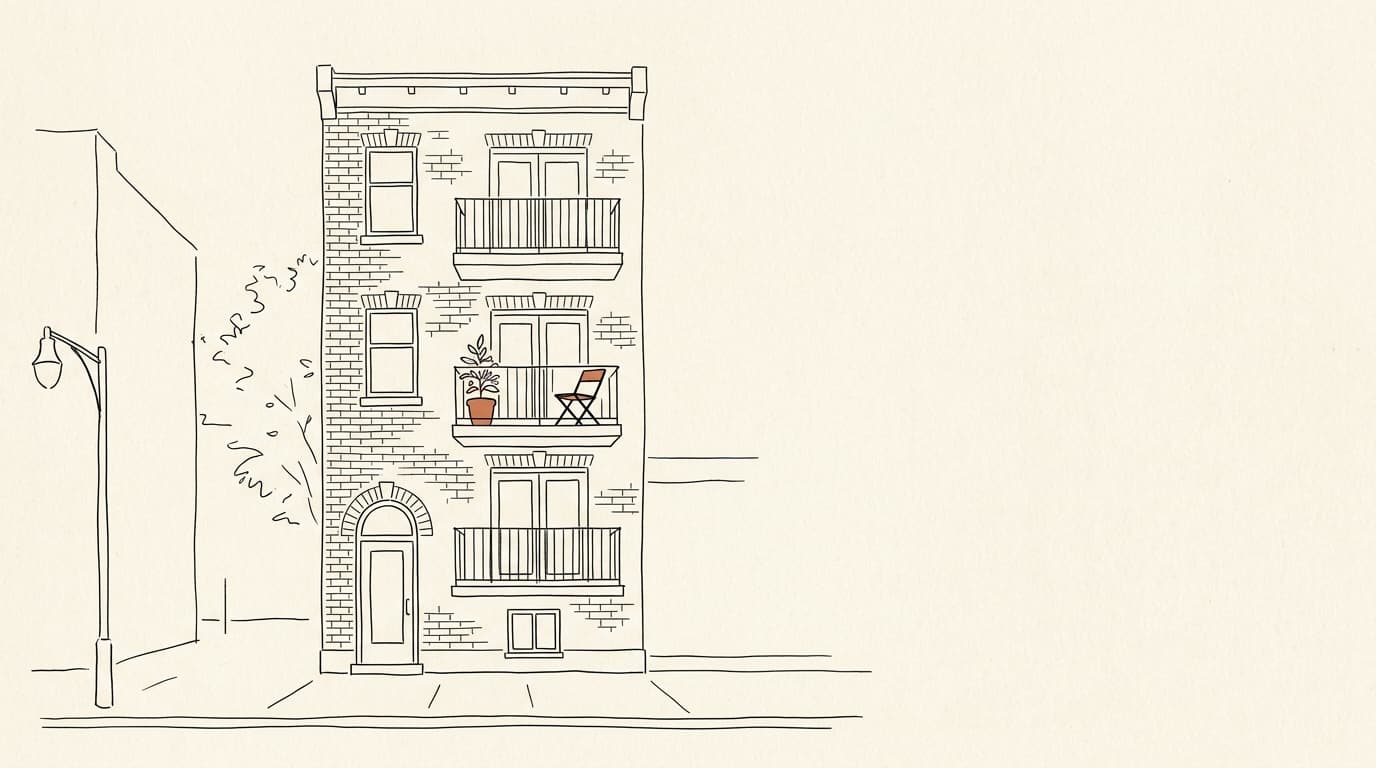
The slab of your balcony is crumbling, a piece of concrete has fallen into the courtyard, and the syndic replies that ‘the balcony is private, so it is at your expense’. Or the other way round: you want to replace the tiles, and a neighbour insists that a vote is needed. Who is right?
The answer first: put like that, the question ‘balcony, common or private part?’ has no answer in Belgium. A balcony is not a single object. It is an assembly of four elements, and each can have its own status, its own payer and its own decision rule.
Belgian law does not classify balconies
No list.
The Civil Code says nowhere that a balcony, a terrace or a railing is common or private. It leaves that work to the deed of division (basisakte / acte de base)GlossaryNotarial deed that describes the building or group of buildings, its private and common parts, and sets the share of the common parts attached to each unit. Together with the co-ownership regulations, it forms the articles of the building and must be transcribed. See the glossary, which describes the building, its private parts and its common parts, and to the co-ownership regulationsGlossaryNotarial deed setting out the rights and obligations of the co-owners regarding the private and common parts, together with the reasoned criteria and the calculation method for allocating charges. Together with the deed of division, it forms the articles of the building. See the glossary, which set the reasoned criteria and the method of calculating the allocation of charges (art. 3.85, § 1). The page that notaire.be devotes to the articles makes the point: it is the deed of division that distinguishes the common parts from the private ones, and the regulations that allocate the repair costs.
Many pages about balconies are written for the Netherlands or France, where the system is different. They tell you nothing about a building in Ixelles or in Ghent.
When the articles do not decide, one rule remains, and it fits in one sentence.
“Where the titles are silent or contradictory, the parts of buildings or land intended for the use of all the co-owners or of some of them are deemed common.”Art. 3.84, para. 3, Civil Code
The presumption therefore works in favour of common, never of private.
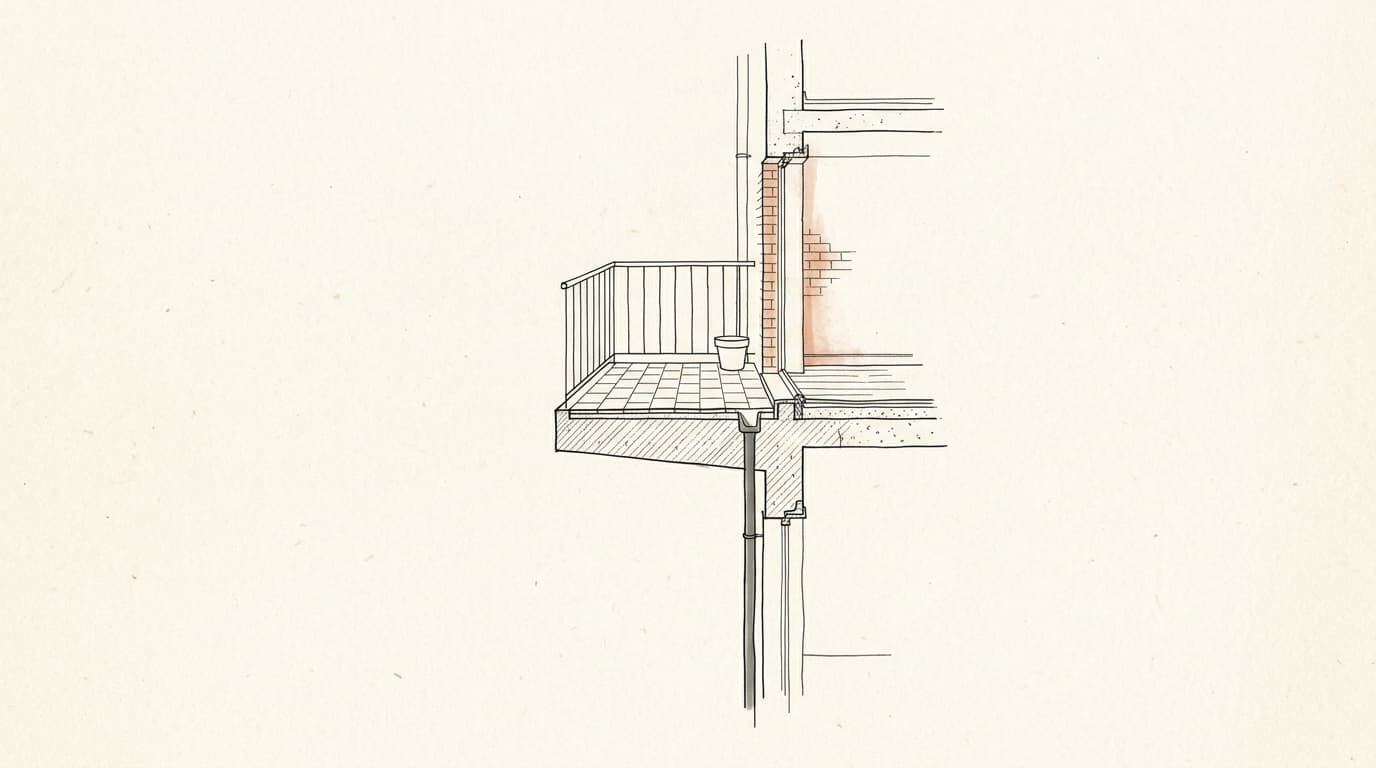
One balcony, four elements, four possible answers
Belgian deeds of division do not all treat the balcony in the same way: some place it as a whole within the unit, others leave it among the common parts while reserving its use to the apartment, others again split it up. And even when the deed says ‘the balcony is private’, the co-ownership regulations often provide otherwise for the structure or the external appearance. You therefore have to read element by element:
- the slab and its load-bearing structure, which extend the building’s shell;
- the waterproofing and the drainage, which protect the floor below;
- the surface, tiles or wooden boards, that you walk on;
- the railing, which can be seen from the street and shapes the façade.
The table shows what is often found in articles. It does not replace reading your own, which may decide otherwise.
| Balcony element | Frequent classification | Usual allocation of costs | What to look for in your articles |
|---|---|---|---|
| Slab and load-bearing structure | Variable, often linked to the common shell | Service charge when the element is common | The list of common parts in the deed of division |
| Waterproofing and drainage | Often treated as common | Service charge, allocated by the regulations’ key | The regulations’ clause on terraces and balconies |
| Surface (tiles, boards) | Often left to the user | Borne by the unit that has the use of it | The description of the unit and the maintenance clause |
| Railing | Variable depending on the articles | Variable | The rules on the appearance of the façade |
Two readings of that table. The first: the more an element relates to the soundness or protection of the building, the more likely it is to be common, because it serves everyone. The second is less intuitive. A private element is not therefore free: the appearance of the façade is often protected by the articles, and a railing you pay for alone can remain subject to a set model.
Our reading: anyone who says ‘the balcony is private’ or ‘the balcony is common’ without having opened the deed of division does not know. Ask for the article in the articles.
‘It only serves me, so it is mine’
The objection is serious, and it comes back at every general meeting (GM). You are the only one with access to that balcony, nobody else sets foot on it. Why would it belong to everyone?
Because use and ownership are two different things. An element can remain among the common parts and still be reserved for a single unit: this is called a common part with exclusive right of useGlossaryRight of exclusive use over a common part, such as a garden or a roof terrace, granted to a unit by the articles. The element remains a common part; the co-ownership regulations specify how its costs are shared. See the glossary. Whoever has that use does not become its owner. The presumption in article 3.84 also targets parts intended for the use of all the co-owners ‘or of some of them’: serving a few is not enough to leave the common.
The opposite objection exists too. ‘It is common, so everyone pays for everything.’ No more so. The co-ownership regulations usually specify what remains borne by everyone, often the waterproofing and the structure, and what falls to the user, often routine maintenance and the damage they cause. A planter that blocks the outlet and causes a leak is not a service charge.
The nuance therefore lies in two separate questions, which are almost always confused: who owns the element, and who bears its costs? The first is read in the deed of division. The second in the co-ownership regulations, with their allocation keyGlossaryCalculation rule that determines each unit's share of a category of charges: shares, metered consumption or another reasoned criterion. The criteria and the calculation method are set out in the co-ownership regulations. See the glossary. The two answers do not necessarily coincide, and that is allowed. The page on private and common parts sets out that dividing line for the other elements of the building, window frames included.
Who decides on works to a balcony?
The status of the element determines the decision. On a private part you act alone, in compliance with the articles and the house rules. As soon as the works touch a common part, the meeting takes over again.
| Project | Decision required |
|---|---|
| Replacing a private surface without touching the waterproofing or the external appearance | No vote, in compliance with the articles |
| Repairing a common slab or waterproofing | Two thirds of the votes; absolute majority for protective works or works required by law |
| Having the association carry out works on private elements, all the railings for example | Two thirds of the votes, with specific reasons |
| Granting or withdrawing exclusive use of a terrace | Two thirds of the votes, then a deed before a notary |
| Changing the allocation of charges for the balconies | Four fifths of the votes |
These thresholds come from article 3.88, § 1, and how the votes are counted is explained in the page on voting rules and majorities. One point on the third row is worth knowing: when the meeting decides that the association will itself carry out works on certain private parts, for technical or economic reasons, it organises the works. It does not change how the cost is allocated between the co-owners.
That leaves urgency. Concrete that threatens to fall on the pavement does not wait for the next meeting: the syndic is responsible for protective acts (art. 3.89, § 5, 2°), which covers making the area safe, not a full renovation. And if the meeting cannot reach the majority for urgent and necessary works to the common parts, any co-owner can ask the court for authorisation to carry them out alone, at the association’s expense (art. 3.92, § 5).
The vote does not settle everything. Enclosing a balcony or changing its appearance may require a permit. In Flanders, according to the Flemish Government, you in principle need an environmental permit (omgevingsvergunning) for any work with a spatial impact, some smaller works are exempt or only require notification, and the municipality can impose stricter rules: so always check with your municipality (gemeente). In the Brussels-Capital Region, it is a planning permit under the CoBAT/BWRO.
What if your articles are silent or contradict each other?
Many old deeds are terse. Some describe the apartment ‘with its balcony’ without saying anything about the slab; others place the balcony within the unit on one page and the façades among the common parts on the next.
In that case, start from common. That is what the presumption requires, and it is the least risky position: order nothing before a decision, report the defect to the syndic in writing, and ask for the item to be put on the agenda. If the meeting wants to fix the rule once and for all, it amends the articles, which requires a vote by special majority and then a notarial deed. The page on the deed of division and regulations explains how to read these texts and how they are amended.
Where the allocation of charges has become inaccurate as a result of changes to the building, the law allows you to ask the court to correct it (art. 3.92, § 7). That is a last resort.
A typical case: the slab crumbling on the second floor
Take a case built for the example: a six-unit building in Ghent, and a second-floor balcony whose concrete is cracking on the underside. The syndic writes to the owner that the balcony belongs to their unit.
The reading takes three steps. Does the deed of division place the balcony among the private parts, the common parts, or the common parts with exclusive use? Suppose it mentions ‘the apartment with its balcony’ and, further on, lists ‘the load-bearing walls and the shell’ among the common parts. Do the co-ownership regulations contain a clause on balconies? Suppose they put ‘maintenance of surfaces’ on the occupier and say nothing about the structure. That leaves the presumption: between a title that contradicts itself and regulations that are silent, the slab is deemed common.
The owner will therefore pay their share of the repair according to their shares (aandelen / quotités)GlossaryFraction of the common parts attached to each unit, set in the deed of division according to the respective value of the private parts. Shares determine the number of votes at the general meeting and can only be changed with the unanimous agreement of all co-owners. See the glossary, not the whole bill. Relaying the tiles remains at their expense. And the meeting would do well to clarify the regulations for the other five balconies, which will age in the same way.
Water gets through to the neighbour below: who pays?
Two bills, two logics. Repairing the element at fault follows its status: if the waterproofing is common, the association repairs it and everyone pays their share, including the owner who suffered the damage. Damage inside the apartment below falls under the insurance policies and any claim against whoever is responsible. The order of the steps is described in the page on water damage and leaks.
The right question is therefore never ‘is my balcony common or private?’. It is: which element are we talking about, and which article of my articles covers it?
Frequently asked questions
Is the railing of my balcony common or private?
Your articles say so, and the answer varies from building to building. Even where the deed of division places it among the private parts, the appearance of the façade is often protected by the articles: you do not choose the model and colour on your own. If the titles are silent, the presumption of article 3.84 of the Civil Code applies, and it leans towards common.
Can I enclose my balcony or add a conservatory?
Not without a decision. Enclosing a balcony affects the façade, and therefore the common parts: works affecting them are voted by a two-thirds majority of the votes (art. 3.88, § 1, 1°, b). A permit may also be needed: in Flanders, in principle an environmental permit (omgevingsvergunning) for any work with a spatial impact, in Brussels a planning permit under the CoBAT/BWRO.
Who pays for waterproofing a terrace I have exclusive use of?
The co-ownership regulations set the allocation of costs. The terrace remains a common part, and a common allocation leaves the surface to the user and treats the waterproofing as a service charge. Only reading your regulations can confirm it.
Is the rule the same in Flanders and in Brussels?
Yes for co-ownership: it falls under the Civil Code, articles 3.78 to 3.100, which is the same in every region. The differences concern spatial planning, that is, the permit that may be needed to change the appearance of a balcony.