Syndic not responding: wait, dismiss or go to court?
When a syndic stops responding, you have three ways out in Belgium: not renewing the mandate when it expires, dismissing the syndic at the general meeting, or asking the justice of the peace for a provisional syndic. The right one depends on two things: when the mandate ends and whether you can get a meeting together.
Contents of this post
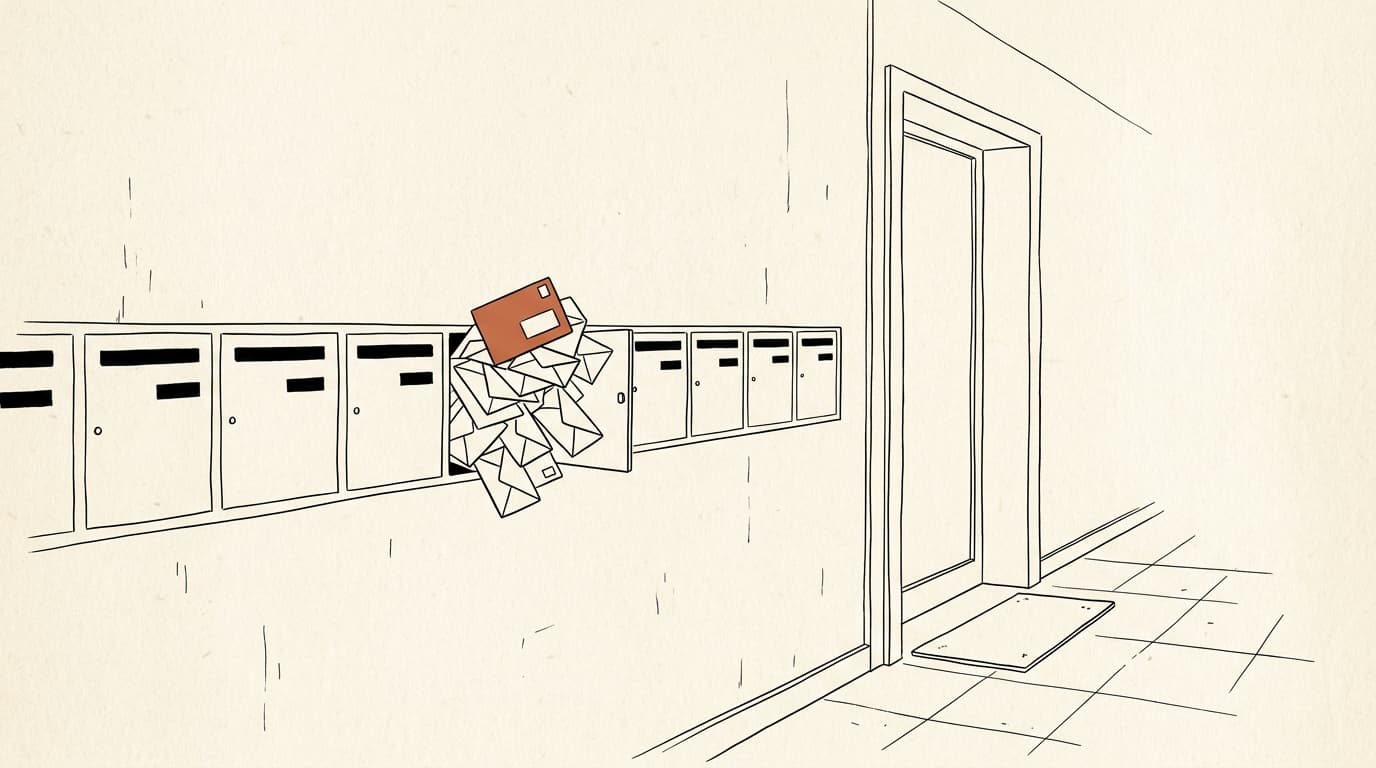
Three emails since September, two voicemails, and still nothing. The leak in the stairwell is waiting, and so is the service charge statement. At this point, most co-owners hesitate between being patient a little longer and "making a complaint", without really knowing against whom or to whom.
There are in fact three ways out, and they are not equal. Much of what you find online on this subject comes from the Netherlands and talks about the VvE and the kantonrechter: that does not describe your building. In Belgium, everything happens within the Civil Code, between the general meeting (GM) and the justice of the peace.
Before you choose, measure the silence
A slow syndic is not the same as a syndic who is failing.
The difference matters, because it determines the way out. The yardstick is the set of duties the law gives the property manager (syndic): carrying out the decisions of the general meeting (art. 3.89, § 5, 1°), taking protective measures when a problem cannot wait (2°), giving access to the co-ownership's documents (9°). An unanswered email about the colour of the entrance hall counts for nothing. Works voted but never ordered, a leak reported three times, an annual general meeting that never comes: now you have something.
So, before taking any step, gather:
- your written, dated requests and proof that you sent them (registered post remains the benchmark);
- the latest minutes, to spot decisions that were never acted on;
- the syndic contract, with its end date and its clauses on notice and compensation;
- the list of co-owners ready to sign with you, and their shares.
If your building has a co-ownership councilGlossaryBody made up of co-owners, mandatory in buildings with at least twenty units, excluding cellars, garages and parking spaces. It ensures that the syndic carries out their duties properly. See the glossary, go through it: it can inspect and copy all management documents, after informing the syndic (art. 3.90). It is often the quickest way to get an answer.
The three ways out, side by side
| Waiting for the mandate to expire | Dismissal at the general meeting | Provisional syndic through the court | |
|---|---|---|---|
| Who decides | The general meeting, by not renewing the mandate | The general meeting, by absolute majority | The justice of the peace, at a co-owner's request |
| Condition | None: the mandate lasts 3 years at most | No reason required | The syndic is prevented from acting or is failing in their duties |
| Does a meeting have to be held? | Yes, when the mandate expires | Yes, if necessary at the request of one fifth of the shares | No |
| Financial risk | No compensation for mere non-renewal | Compensation if the contract provides for it, damages if the dismissal is wrongful | The costs of proceedings |
| Suits you when | The end date is close and the building still runs | The majority is there and a successor is ready | The building has come to a halt and no meeting can be held |
The three columns are not mutually exclusive. They often follow one another: you prepare the dismissal, hit a wall over convening the meeting, and end up before the court.
Waiting for the mandate to expire: the free way out, but until when?
This is the route people forget because it does not look like action. A syndic's mandate may not exceed three years, it is only renewed by express decision of the general meeting, and "the mere fact of not renewing the mandate cannot give rise to compensation" (art. 3.89, § 1). No reason, no argument about fault, no cheque.
Our reading: if the mandate ends within a few months and the bills are being paid, waiting is the least risky choice. Use the time to consult possible successors and have the appointment put on the agenda. The timetable and the handover of the records are covered in the page on changing your syndic.
Waiting becomes a bad bet in two cases. When the silence causes damage that keeps growing, a leaking roof for example. And when the end date has passed without anyone noticing: a mandate that has not been expressly renewed does not continue on its own.
Dismissal at the general meeting: quick if the majority is there
The general meeting "may dismiss the syndic at any time" (art. 3.89, § 7). No reason to give, no special majority: an absolute majority of the votes of those present or represented is enough. Instead of dismissing the syndic, the meeting can also appoint a provisional syndic alongside them for a set period or a set task, which sometimes resolves a single blocked file without breaking the contract.
The price is in the contract. A termination compensation clause applies if there is one, and a dismissal found to be wrongful can cost damages. Hence the value of your file of documents: the law does not require a reason, but minutes based on dated facts are easier to defend than a list of grievances.
Vote everything at the same meeting: the dismissal, its effective date, the successor's name, their contract. A building without a syndic between two meetings is an association that nobody represents. The page on dismissal and resignation of the syndic explains the vote and how compensation is calculated.
What if the syndic refuses to convene the general meeting?
That is the logical next step with a silent syndic: they do not respond to the request for a meeting either. The law has provided for this. Co-owners who together hold at least one fifth of the shares in the common partsGlossaryTerm used by the Civil Code for the fraction of the common parts attached to each unit, also called quotités. It is set in the deed of division according to the respective value of the private parts and determines each co-owner's number of votes at the general meeting. See the glossary send their request to the syndic by registered post. The syndic has thirty days from receipt to convene the meeting. After that, any one of the signatories can convene it themselves (art. 3.87, § 2).
Take a typical case, built for the example: a ten-unit building in Ghent, where four co-owners together hold 2,400 shares out of 10,000. The one-fifth threshold, i.e. 2,000, is exceeded. Their registered letter is received on 2 March. With no notice of meeting by 1 April, one of them sends their own, at least fifteen days before the chosen date: the meeting can be held in the second half of April. Six to seven weeks between the registered letter and the vote, with no court and no costs beyond postage.
The sticking point: you need the up-to-date list of co-owners and their addresses, which the syndic holds. Here again, the co-ownership council and previous minutes are a starting point.
You do not reach one fifth? A co-owner can ask the court to order a general meeting to be convened when the syndic fails or wrongfully refuses to do so (art. 3.92).
When should you ask the justice of the peace for a provisional syndic?
When the building has come to a halt.
The text covers two situations, being prevented from acting and failing to act: the court can then appoint a provisional syndicGlossarySyndic appointed by the court when the syndic in office is prevented from acting or fails to act, to manage the co-ownership for a limited period. See the glossary, for the period it sets, at the request of a single co-owner, with the current syndic summoned to the proceedings (art. 3.89, § 8). Being prevented means the syndic can no longer perform the role. Failing means the syndic no longer performs it: unpaid invoices, an abandoned insurance claim, a general meeting never held. No share threshold, no prior vote. It is the only one of the three ways out that you can take alone.
It has its limits, and we prefer to state them. Proceedings take time and require you to prove the failure, not just your frustration. The provisional syndic sorts out the management, not the past: if mistakes have caused damage, it is the association that will have to act, on the basis described in the page on syndic liability.
There is a free intermediate step. Conciliation is requested by a simple letter to the justice of the peace, and the record of an agreement has the same value as a judgment. Our reading: a summons from the court registry carries more weight than a fourth email, and it closes no other door. How to bring a case is explained in the page on justice of the peace and co-ownership disputes.
Professional syndic: does a complaint to the BIV change anything?
It does not replace any of the three ways out. A syndic who works professionally as a self-employed person must be accredited by the Professional Institute of Real Estate Agents (BIV/IPI)GlossaryBody that regulates the profession of estate agent in Belgium, on the basis of the Act of 11 February 2013. Anyone who works as a self-employed syndic must be licensed by the BIV/IPI. See the glossary, and the Institute receives complaints against an accredited agent who has committed ethical breaches. Its disciplinary body can only act on that ground: it does not appoint another syndic, does not convene your general meeting and does not give legal advice on your case.
A complaint therefore makes sense alongside the rest, never instead of it.
Our choice, profile by profile
In a small building where co-owners talk to each other, dismissal followed by an immediate appointment is almost always the right route: you can count the majority on your fingers, and a request from one fifth unblocks the meeting. In a large co-ownership where nobody knows anyone, gathering signatures takes weeks, and the end of the mandate, if it is approaching, becomes the date to prepare for.
We keep the court for buildings where nothing works any more: no meeting possible, suppliers unpaid, an insurance claim left pending. Only in that case should you wait neither for the end of the mandate nor for a majority.
One thing does not change from one profile to another. Keep paying your service charges: they are owed to the association, and that is what you would be weakening.
Frequently asked questions
Can I stop paying my service charges while the syndic is not responding?
No. Your charges are owed to the owners' association, not to the syndic personally, and the association can recover them through the courts. Suspending your payments puts you in the wrong without moving the matter forward.
Can a single co-owner dismiss the syndic?
No, dismissal is a decision of the general meeting, taken by absolute majority of the votes of those present or represented. On your own, you can ask for the item to be put on the agenda or, if management has come to a halt, ask the justice of the peace to appoint a provisional syndic (art. 3.89, § 8).
Do I need a lawyer to ask for a provisional syndic?
A lawyer is not mandatory before the justice of the peace: you can represent yourself. Their help is still useful for drafting the originating application and presenting the documents that show the syndic is failing in their duties.
Are volunteer syndics subject to the same rules?
Yes. The duties in article 3.89 of the Civil Code apply to every syndic, paid or not, and the general meeting can dismiss them in the same way. A disciplinary complaint to the BIV/IPI, however, only concerns accredited estate agents.
How long does the outgoing syndic have to hand over the file?
Thirty days from the end of their mandate. They must hand the entire management file to their successor, including the accounts and assets (art. 3.89, § 5, 7°).