GM quorum not reached: what happens next?
If the quorum is not reached, the general meeting cannot decide anything that day. A second meeting is held after at least fifteen days, and it deliberates whatever the number of people present. The majorities do not change. Before packing up, redo the calculation all the same: there are two quorums.
Contents of this post
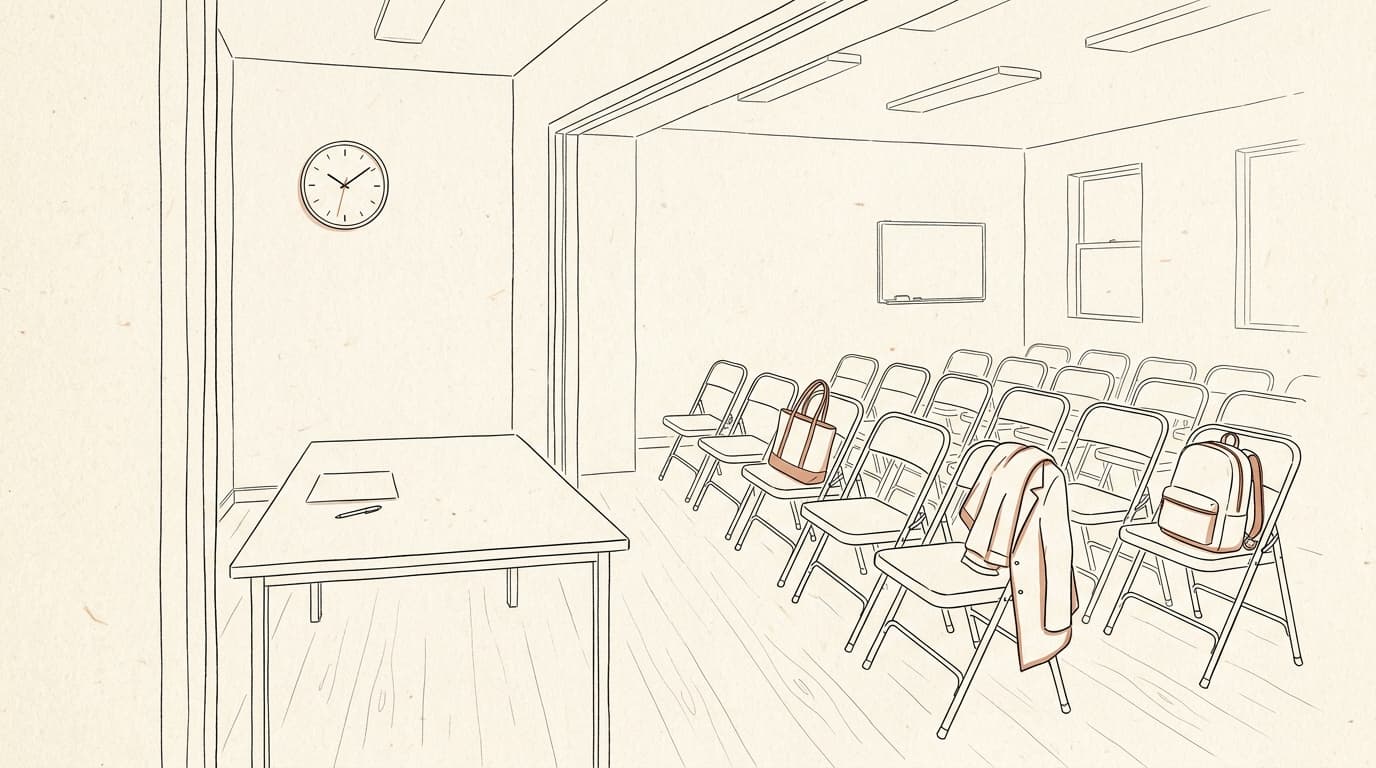
It is 7.15 pm, the room is booked, and the attendance list has five signatures. The property manager (syndic) counts, counts again, then announces that the quorum has not been reached. Does everyone go home?
Yes, but not before the calculation has been checked. The rule fits in one paragraph of the Civil Code, Article 3.87, § 5, which is the same in Flanders and Brussels.
Has the quorum really been missed? Two calculations to redo
The quorumGlossaryMinimum attendance required for the general meeting to deliberate validly: more than half of the co-owners holding at least half of the shares, or co-owners holding more than three quarters of the shares. Failing that, a second meeting held at least fifteen days later deliberates without any quorum requirement. See the glossary is assessed at the start of the meeting, and there are two ways of reaching it. It is the second one people forget.
First calculation, with a double condition: more than half of the co-owners present or represented, together holding at least half of the shares (quotités)GlossaryTerm used by the Civil Code for the fraction of the common parts attached to each unit, also called quotités. It is set in the deed of division according to the respective value of the private parts and determines each co-owner's number of votes at the general meeting. See the glossary in the common parts. Second calculation, on shares alone: if those present and represented hold more than three quarters of them, the general meeting (GM) deliberates validly, whatever their number.
Take a typical case, built for the purpose of the example: a twelve-unit building in Mechelen, twelve co-owners, 10,000 shares.
| In the room (present and represented) | Shares held | Quorum |
|---|---|---|
| 5 co-owners out of 12 | 4,600 | Not reached: neither a majority of people nor half of the shares |
| 7 co-owners out of 12 | 4,800 | Not reached: enough people, not enough shares |
| 7 co-owners out of 12 | 5,000 | Reached under the first calculation |
| 4 co-owners out of 12 | 7,600 | Reached under the second calculation, more than three quarters |
So before closing the meeting, check the following:
- the proxies have indeed been added to the attendance list, with each principal's shares;
- each proxy names its holder, as the law requires;
- the shares used are those in the deed of division (acte de base / basisakte), not just a count of units;
- the second calculation, the three-quarters one, has been done.
In small buildings where two or three large apartments carry a lot of weight, that last check saves more than one meeting. The details of votes and caps are in the page on voting rules and majorities.
What happens to today's meeting?
As far as decisions go, it ends there. Without a quorum, the general meeting does not deliberate validly on any item.
Nothing prevents those present from discussing the quotes or putting their questions to the syndic, and that often saves time for later. Our advice: have the attendance list signed and keep it, together with the proxies. It proves that the quorum was lacking, and therefore that the second meeting is properly held.
When can the second meeting take place?
After a period of at least fifteen days. The text sets a floor and no ceiling.
The second meeting is not a continuation of the first: it is convened afresh, in the usual way. Registered post, except for co-owners who have agreed in writing to another means, at least fifteen days before the date, with the place, time and agenda. The requirements are set out in the page on the notice of general meeting.
In our typical case, the first meeting is held on Tuesday 3 March. A notice posted on 5 March allows the second meeting to be held from 24 March, leaving a few days' margin for delivery. Three weeks, then, at best. If the ordinary general meeting had to be held within the fifteen-day window set by the house rules (ROI), the timetable slips by the same amount: the page on organising a general meeting shows how to rebuild it.
With three people in the room, can the roof be voted?
Yes. The second meeting deliberates whatever the number of members present or represented and the shares they hold. This is the rule that surprises people most, and the one absentees discover when they receive the minutes.
The majorities, on the other hand, remain those set by law. Works to the common parts still require a two-thirds majorityGlossaryMajority required in particular for works affecting the common parts, other than works required by law and protective works, and for amendments to the articles that concern only the enjoyment, use or management of the common parts. See the glossary, as Belgium's notaries point out. Only, those two thirds are calculated on the votes of those present and represented, abstentions excluded (art. 3.87, § 8).
Back to Mechelen. On 24 March, three co-owners turn up, holding 2,900 of the 10,000 shares between them. The roof renewal receives 2,000 votes for and 900 against, or 69% of the votes cast. Carried. A decision binding all twelve units has been taken by 20% of the building's shares, and it applies to everyone.
One safeguard remains: nobody may vote with more votes than the total of the votes of the other co-owners present or represented (art. 3.87, § 6). A dominant owner therefore does not decide alone against two neighbours.
In short: absence blocks nothing. It pushes the decision back by three weeks and hands it to those who turn up. If an item matters to you, the second meeting is the one not to miss.
Five situations, and what to do
| Situation | Consequence | What to do |
|---|---|---|
| Quorum narrowly missed at the opening | No decision possible | Redo both calculations, including proxies, before closing the meeting |
| Quorum missed, finding recorded | Second meeting after at least fifteen days | Keep the signed attendance list and convene again in due form |
| You were absent from the first meeting | You will be invited to the second | Attend, or give a new named proxy |
| Decision requiring unanimity | The second-meeting rule is not enough | Plan the new meeting after thirty days (art. 3.88, § 4) |
| A vote was held despite the lack of a quorum | Irregular decision, open to annulment | Write to the syndic, then act within four months if necessary |
On the last line, the four-month period runs from the date of the meeting and the challenge is brought before the justice of the peace. How to go about it is described in challenging a GM decision.
Do you need a new proxy?
Yes, in principle. A proxyGlossaryDocument by which a co-owner arranges to be represented at the general meeting by a proxy holder named personally. No one may accept more than three proxies unless their own votes and those of the co-owners they represent do not exceed 10% of the total, and the syndic may not act as proxy holder. See the glossary is valid for one general meeting only, unless it is notarial. The one you signed for 3 March is no longer any use on 24 March.
Draw up a new one, in the name of a specific person, who cannot be the syndic. Also check that your proxy holder does not already hold three: beyond that, they can only accept more if their votes and those of their principals do not exceed 10% of the total votes in the building (art. 3.87, § 7).
A second meeting is decided by a handful of votes. Yours carries more weight there than at the first.
Frequently asked questions
What is the quorum for a co-owners' general meeting in Belgium?
More than half of the co-owners must be present or represented and hold at least half of the shares in the common parts. The general meeting also deliberates validly if those present and represented hold more than three quarters of the shares, whatever their number (art. 3.87, § 5, Civil Code).
Do proxies count towards the quorum?
Yes. The quorum is based on the co-owners present or represented. A co-owner who has given a valid named proxy is counted, with their shares, as if they were in the room.
How long do you have to wait before the second meeting?
At least fifteen days after the first (art. 3.87, § 5, Civil Code). The law sets a minimum, not a maximum. Since the second meeting is convened in the usual way, also allow for the fifteen-day notice period.
Is there a quorum at the second meeting?
No. It deliberates whatever the number of members present or represented and the shares they hold. Three co-owners out of twelve can therefore take valid decisions.
Are majorities easier to reach at the second meeting?
The thresholds do not change: absolute majority, two thirds or four fifths depending on the decision. They are calculated on the votes of those present and represented, excluding abstentions. With few people in the room, few votes are therefore enough in practice.
Can a decision requiring unanimity be voted at the second meeting?
Unanimity follows its own rule. It is based on the votes of all co-owners. If it fails because of absences, a new general meeting is held after at least thirty days, and the decision can then be taken unanimously by those present or represented (art. 3.88, § 4, Civil Code).
Does my proxy for the first meeting also cover the second?
In principle, no. A proxy is valid for one general meeting only, unless it is a notarial proxy. Give a new one, naming your proxy holder, for the date of the second meeting.
The general meeting voted without a quorum. What can I do?
Point it out to the syndic in writing and ask for the item to be put again to a properly constituted general meeting. If the decision stands and causes you personal harm, you can ask the justice of the peace to annul it within four months of the meeting (art. 3.92, § 3, Civil Code).