Getting an item onto the GM agenda
For an issue to be voted on at the next ordinary meeting, your written request must reach the syndic at least three weeks before the first day of the period set in the house rules. Word it as a decision to be taken, attach the documents and keep proof of the date it was received.
Contents of this post

The garage door has been creaking for two winters, the bike store is overflowing, or you would like the building finally to compare its lift contracts. You mentioned it to the property manager (syndic) in the entrance hall. He nodded. And at the next meeting, nothing: the issue was not on the agendaGlossaryList of items to be discussed and voted on by the general meeting, included in the notice of meeting. Any co-owner, or the co-ownership council, can ask the syndic to add an item. See the glossary, so nobody could vote on it.
A conversation is not enough. You need something in writing, sent at the right time. The rule is the same in Flanders and in Brussels, it fits into two paragraphs of the Civil Code, and it tends to work in your favour.
Until when can you request an item?
The right itself has no date: one or more co-owners, or the co-ownership councilGlossaryBody made up of co-owners, mandatory in buildings with at least twenty units, excluding cellars, garages and parking spaces. It ensures that the syndic carries out their duties properly. See the glossary if there is one, can ‘at any time’ send the syndic the items to be put on the agenda (Art. 3.87, § 4, of the Civil Code). You do not need anyone’s backing. A single unit is enough, whatever its size.
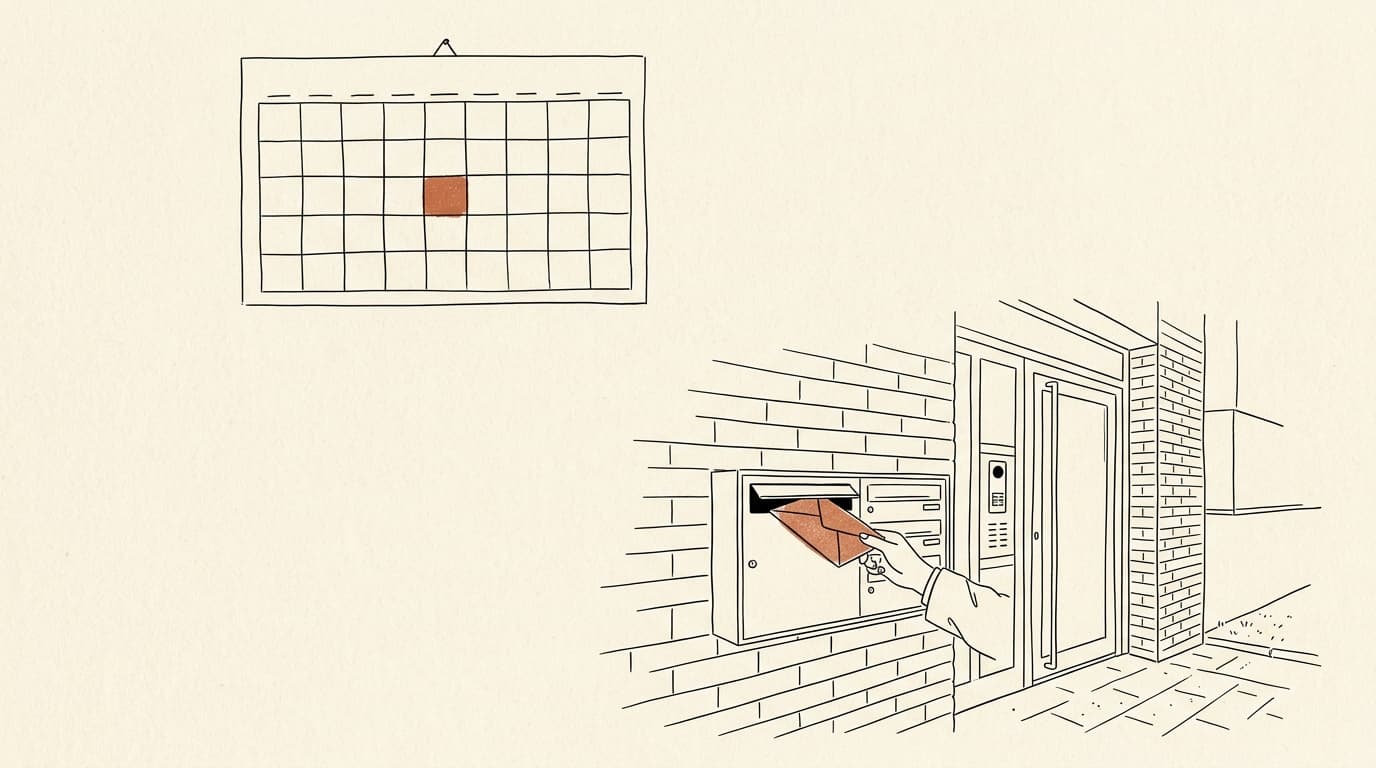
What does have a date is the meeting at which the item will be dealt with. The syndic puts on the agenda the written proposals received at least three weeks before the first day of the period, set in the house rules (ROI / RIO)GlossaryRules drawn up by private agreement that set out at least how the general meeting operates, how the syndic is appointed and the fortnight in which the ordinary general meeting is held. They are kept at the association's registered office and can be consulted free of charge. See the glossary, during which the ordinary general meeting (GM) must take place (Art. 3.87, § 3). Three words count in that sentence. ‘Written’: no oral requests. ‘Received’: what counts is arrival at the syndic’s, not when you sent it. And ‘period’: the calculation starts from the first day of the fortnight set in the house rules, not from the date of the meeting, which you do not even know yet.
Take a typical case, built for the example: a twelve-unit building in Ghent whose house rules set the ordinary meeting in the second half of March, from the 16th to the 31st. In 2027, the request must reach the syndic by 23 February at the latest. Posted on the 22nd, it may well arrive too late.
| Your situation | Deadline | Consequence |
|---|---|---|
| Request received three weeks or more before the first day of the period | In the typical case: 23 February at the latest | The item goes on the ordinary meeting’s agenda |
| Request received after that date | None | The item goes on the following meeting’s agenda |
| Issue that cannot wait | Notice within thirty days of receiving the request | Meeting at the request of one fifth of the shares, sent by registered post |
| Notice received without your item, requested in time | Before the meeting | Written reminder to the syndic, copied to the co-ownership council |
Our advice: do not wait until the last week. Nothing stops you sending the request two or three months ahead, and the syndic will then have time to gather quotes.
How do you word the request so it gets voted on?
A badly worded item can make it onto the agenda and lead nowhere. ‘Discuss the garage’ calls for no vote. The request should look like what the meeting will decide.
- Open the house rules. Note the period of the ordinary meeting and work out your deadline, as in the typical case. If you do not have the house rules, they can be consulted free of charge at the association’s registered office.
- Write a proposed decision. For example: ‘Replacement of the garage door motor: choice of contractor from the attached quotes, maximum budget, funded from the reserve fund.’ One sentence, one subject, one decision.
- Give your reasons in a few lines. How long the problem has existed, what it costs or may cost, what you propose. Ten lines are enough.
- Attach the documents. Quotes, dated photos, a letter from the municipality or the insurer. The notice must say how to consult the documents relating to the agenda items: they might as well exist.
- Send it with proof of receipt. Registered post, or an email to which the syndic replies in writing. Note the date.
- Check the notice. It must be sent at least fifteen days before the meeting. Your item must be on it, in your own words.
Before sending, reread your request against this list:
- the proposed decision fits in one sentence and can be voted on with a yes or a no;
- the amount, or at least a ceiling, is stated when there is an expense;
- the funding is specified, reserve fund or call for funds;
- the attachments are referred to in the text.
Also think about the majority your item will need. Works affecting the common parts are not voted on like a change of supplier: the page on voting rules and majorities gives the thresholds, and the consolidated text published by the Professional Institute of Estate Agents (BIV) lets you check the relevant article.
The deadline has passed: is your item lost?
No. If, given the date of receipt, the item can no longer go on the meeting being prepared, it goes on the agenda of the following general meeting (Art. 3.87, § 4). Ask the syndic to confirm this in writing.
Waiting a year is not always workable. In that case, the route is a meeting requested by co-owners who together hold at least one fifth of the sharesGlossaryTerm used by the Civil Code for the fraction of the common parts attached to each unit, also called quotités. It is set in the deed of division according to the respective value of the private parts and determines each co-owner's number of votes at the general meeting. See the glossary. The request goes by registered post, and the syndic sends the notice within thirty days of receiving it (Art. 3.87, § 2). In our twelve-unit building, that means convincing two or three neighbours, depending on the size of the units. The page on organising a general meeting describes what happens next, including the case where the syndic does not respond.
The syndic left out your item: what now?
Start by checking your own file: was the request in writing, and do you have proof it was received within the deadline? If so, proceed step by step.
First, a written reminder to the syndic as soon as you receive the notice, copied to the co-ownership council if there is one. Honest oversights happen, especially with a volunteer syndic preparing their first meeting, and they can be fixed as long as the meeting has not taken place.
Next, the request for a meeting by one fifth of the shares, described above.
As a last resort, the justice of the peace. Any co-owner can ask the court to order a meeting to be called, within the period it sets, to deliberate on the proposal that co-owner specifies, where the syndic neglects or wrongfully refuses to do so (Art. 3.92, § 4). This is a court procedure, with its cost and its duration. We keep it for repeated blockages, not a first oversight. For remedies after a meeting, see the page on challenging a GM decision.
An issue slipped in under ‘any other business’ is not voted on
The temptation is familiar. The deadline was missed, so someone raises a hand at the end of the meeting, there is a show of hands, and the syndic writes it into the minutes.
It is a bad idea, even when everyone in the room seems to agree. The notice must contain the list of items for discussion (Art. 3.87, § 3): absent co-owners decided whether or not to come, and gave their voting instructions, on the basis of that list. A decision taken outside it is exposed to a request for annulment before the justice of the peace, within four months of the date of the meeting (Art. 3.92, § 3).
Better an item on the agenda for next year than a fragile vote this year. If the notice has not gone out yet, there is sometimes still some leeway. Our view: nothing prevents the syndic from adding, of their own accord, an issue that arrived after the three weeks. For everything to do with the form of that document, the page on the notice of general meeting takes over.
Frequently asked questions
Do you need several co-owners to request an item?
No. Article 3.87, § 4, of the Civil Code gives this right to ‘one or more co-owners’, with no threshold of shares. The one-fifth threshold applies only to a request to hold a meeting, not to adding an item to a meeting that is already planned.
Does the request have to go by registered post?
The Civil Code requires a written proposal, without imposing registered post for adding an item. Since everything depends on the date the syndic receives it, choose a method that proves it: registered post, or an email whose receipt the syndic acknowledges in writing.
Can the syndic reword or refuse my item?
The text says the syndic puts on the agenda the proposals received within the deadline: it gives the syndic no right to pick and choose. When the notice arrives, check that your item is on it in your own words, and respond in writing if it is not.
Can a tenant have an item added?
No, this right belongs to the co-owners and the co-ownership council. The syndic must, however, tell occupants without voting rights the date of the meetings, so they can submit written requests or comments on the common parts, which are then passed on to the meeting (Art. 3.89, § 5).
Can you add an item once the notice has been sent?
Not to have it voted on at that meeting. The notice contains the agenda and must be sent at least fifteen days before the meeting, except in an emergency. An item that arrives after that point goes on the agenda of the following meeting (Art. 3.87, § 4).
Can you vote on an issue raised under ‘any other business’?
We strongly advise against it. Absent co-owners could not prepare or give instructions to their proxy, and the decision is exposed to an action for annulment within four months of the meeting (Art. 3.92, § 3). ‘Any other business’ is for sharing information.